This article is written by Elaine Brady Smith
Welcome to Part III of Encaustic Basics Series on how to make it easy and economical to get started with encaustic painting. This article is about adding collage and embedding objects to your encaustic art. Adding collage with encaustic has always seemed like a natural practice to me. It is as though beeswax and paper were made for each other. Encaustic wax gives paper a luminous quality and sometimes makes it transparent, which is great for layering. Let’s get started!
Adding Collage
Collage is my all-time favorite medium and I love working with all types of paper. There are multiple ways to add collage paper to encaustic work and I will discuss two that work best for me. You can follow along as I build a collage piece in this article. I recommend you read the first two articles of the Encaustic Basics Series before you attempt the techniques in this article. You can find Part I and Part II to review them both.
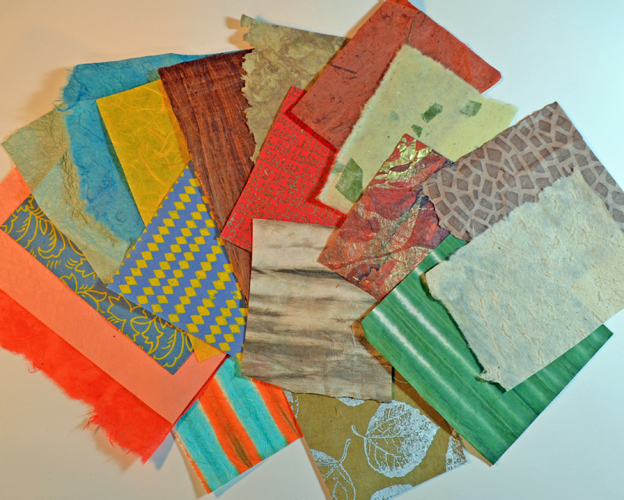
First let’s talk about the paper itself. Handmade papers such as Japanese mulberry or washi, Lokta, lace papers, your own handmade pulp papers, and other natural fiber handmade papers are perfect for encaustic collage. There are many sources to purchase handmade paper in art and stationery stores. Here are a few of my favorite online ordering sites:
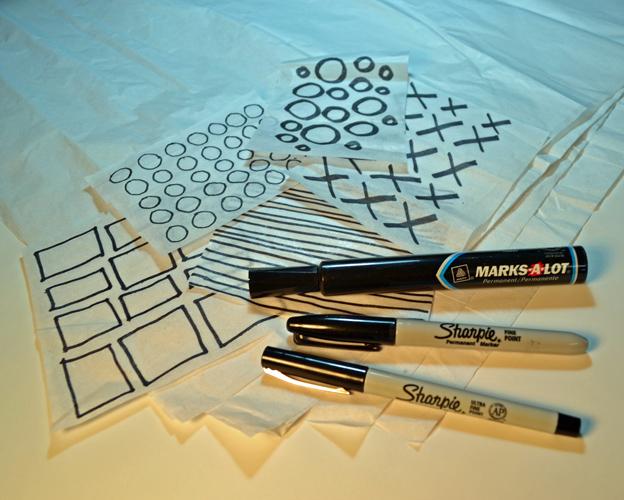
You are certainly not limited to handmade papers for encaustic collage. Tissue paper is a good and inexpensive alternative, whether it is white, colored, or printed. You can build up many transparent layers with tissue paper and incorporate your own marks by drawing or writing on it before you add it to your art. I’ve also known artists who print on tissue paper by running it through their printers on a carrier page, but I have not tried this yet. If you have, let me know how it works!
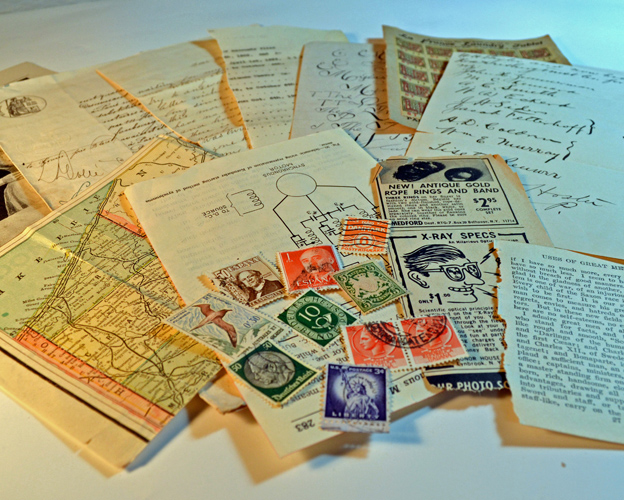
You may also have a stash of vintage papers such as old letters, postage stamps, book pages, or newspapers. I love using old handwritten letters in my art. One note of caution with vintage paper though, is that some older inks will run when dipped into encaustic wax. So it is best to test before you use it. Also wax will make most papers transparent, so whatever is printed on the back side will show through to the front side once it is waxed.
Another great item to use for encaustic collage is printed paper napkins. Just be sure to remove the white backing layers before using them in your art. It is best to just lay the napkin pieces down and fuse right on your surface, rather than a pre-wax method.
Any paper that you use should be absorbent and porous. Some glossy or coated papers, like magazine pages, waxed paper, cook’s parchment, and scrapbooking vellum might not be compatible with encaustic. It is a good idea to test papers with wax before adding to see how they react. One of the cool things about encaustic collage is that if you change your mind, you can always heat and remove a piece of collage from your art and replace it with something else. If you lift it carefully, the collage paper you remove is preserved, and you can reuse it again on another piece. To me this is a beautiful thing!
Methods for Adding Collage
Tacking Iron Method:
If you have a tacking iron and want to dedicate it to your encaustic work, it is a great tool to add and fuse collage papers in one step. A smaller version of the tacking iron is the Clover Iron, which works well for adding small pieces of collage paper. The tacking iron should have a temperature control, which should be set to about medium heat. Since the settings will vary on different irons, you should test the iron before using it on your art. Set it to just melt the wax, but not too hot that it will make the wax smoke.
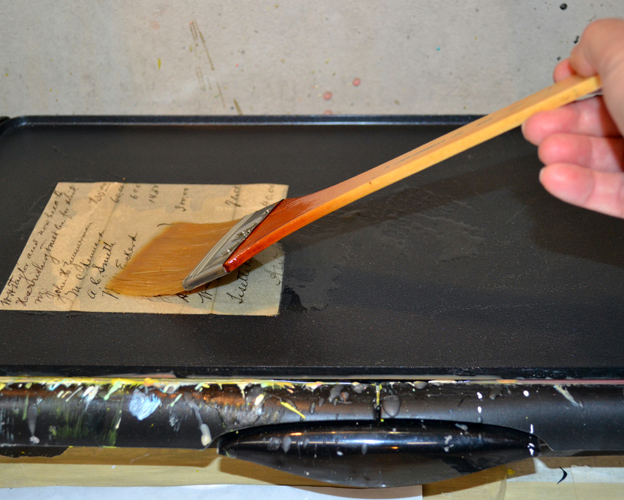
To pre-wax a piece of collage paper for the Tacking Iron Method, place the paper on your palette or griddle. Brush on a thin layer of clear encaustic medium.
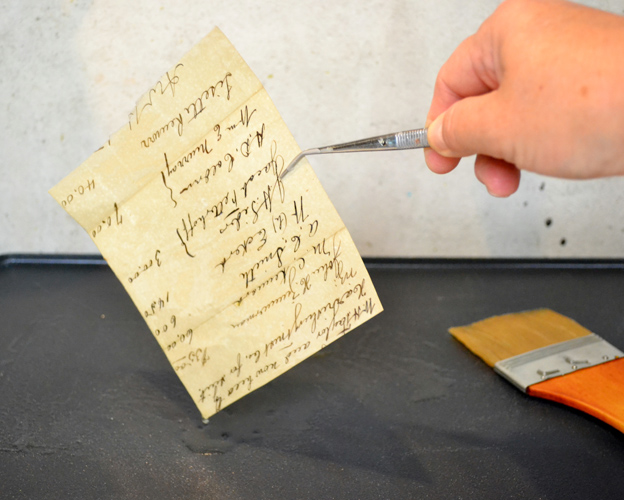
Pick the paper up with a pair of tweezers, and allow excess wax to drip off. It will begin to cool immediately and the wax will harden quickly.
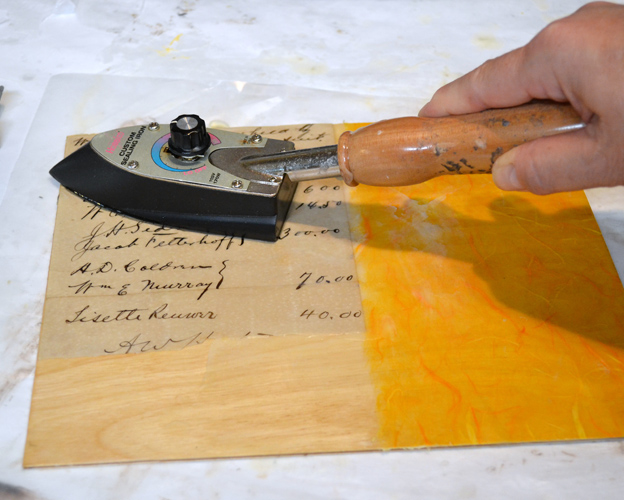
When the pre-waxed collage paper is cool, place it on the surface of your art. With a preheated tacking iron, gently iron the piece into place. Once the wax melts under the tacking iron, the collage piece will be fused. Remove the iron and allow the area to cool.
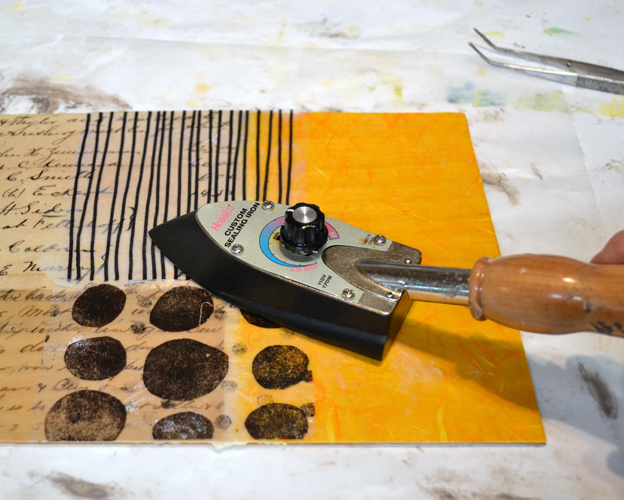
The process of using the tacking iron automatically fuses the wax layers, so there is no need to add any additional heat source. I have added several pieces of vintage handwritten letters and white tissue papers printed with Sharpie Markers.
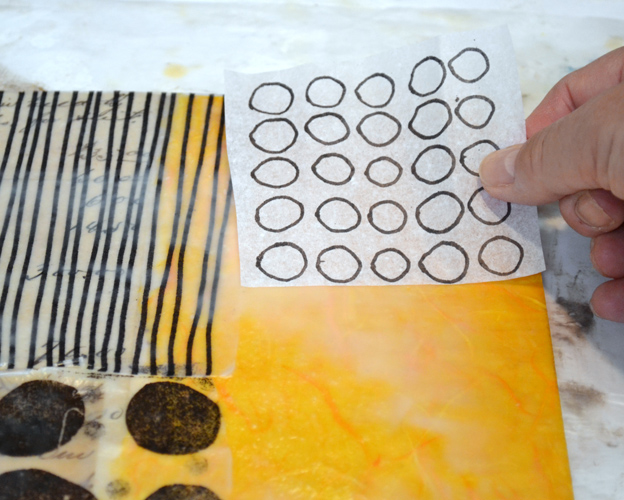
Some very thin papers, like tissue paper may not need to be pre-waxed if you already have a primer layer of wax on your art. Just lay the tissue onto your surface and use the tacking iron to fuse it into place. Once the wax cools, you can add more collage layers to your piece, overlapping them as you go.
Heat Gun/Metal Palette Knife Method:
I have a tendency to work with as few tools as possible, so I have put aside the tacking iron these days and started using the Heat Gun/Metal Palette Knife method for adding collage layers to my work. I like it so much more for the simple reasons that I am using less electricity; have fewer tools on my work table and I have more control over how the collage pieces are applied.
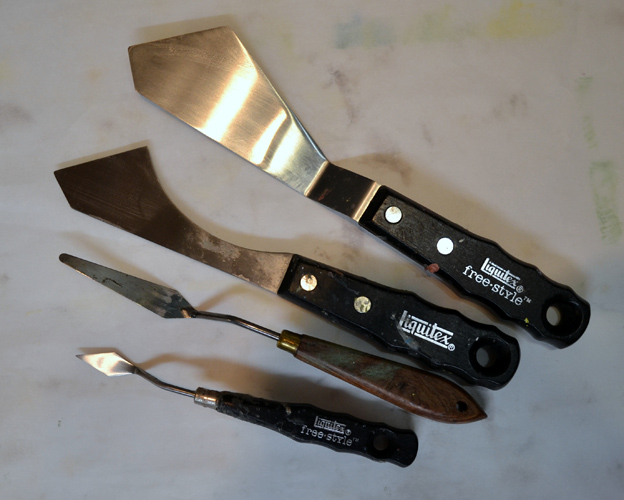
Use metal palette or painting knives for this method. Shown is a selection of my favorite palette knives that I use for encaustic collage.
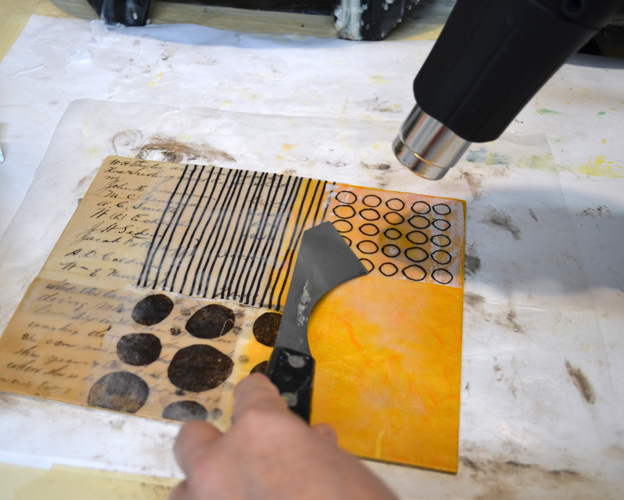
Pre-wax your collage pieces in the same way as the Tacking Iron Method on your hot palette. Place them on your surface and with the palette knife in one hand; use it to hold the collage piece in place. With the heat gun in your dominant hand, fuse the collage piece into place.
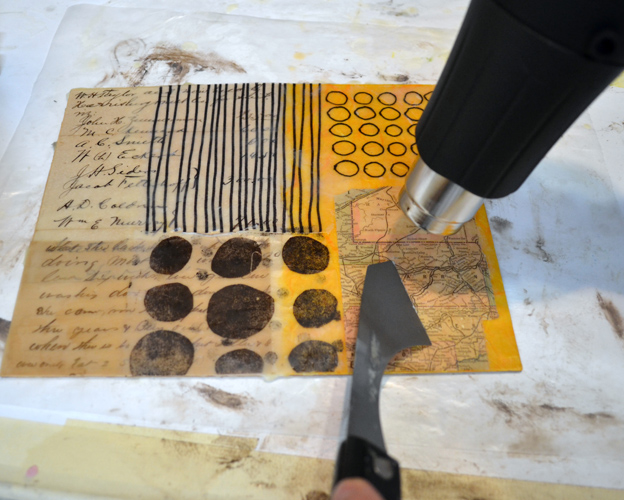
As you are fusing, smooth out the collage piece with the palette knife. Note that this does take some practice, but is not so difficult that you cannot master it after a few tries.
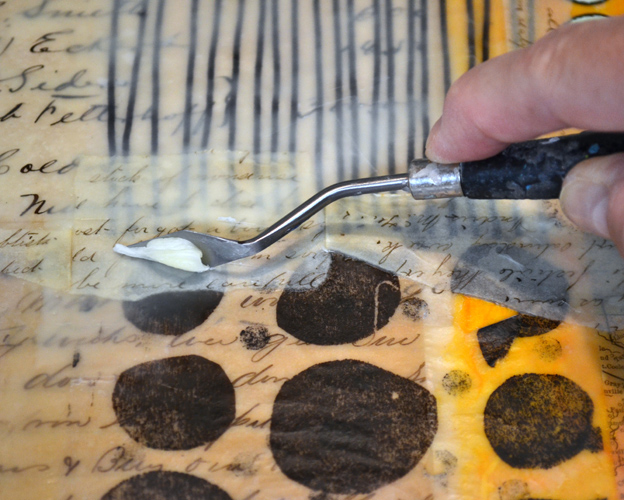
Use a smaller palette knife to smooth the collage piece down, scrapping off excess wax, and easing out air bubbles before the wax cools. I like to use a combination of large and small palette knives for this technique.
Once you discover adding collage to encaustic art, you will love the endless possibilities for adding paper to your work. As another alternative, you can also add non-synthetic or natural fiber fabrics to encaustic art. Natural fabrics like cotton, muslin, and silk work well with encaustic wax. The possibilities for printing and mark making on fabric is as limitless as it is with paper, but I’ll save that topic for another article.
Embedding Objects
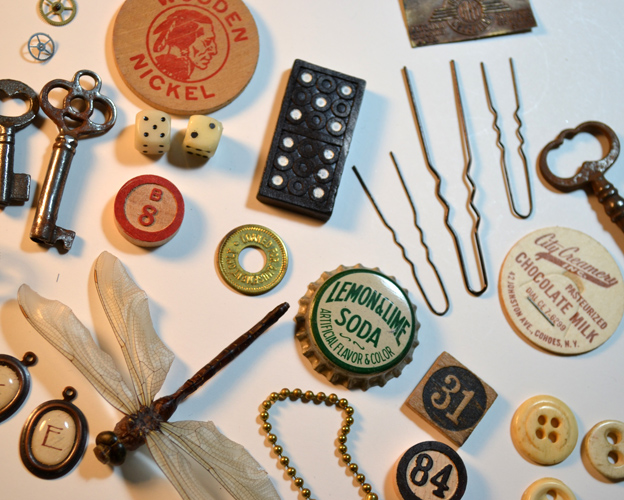
Encaustic wax is great for embedding three dimensional objects to your art. Some objects to add might be buttons, game pieces, jewelry pieces, and natural plant materials. Shown above is a variety of items I might want to embed in an encaustic piece. Encaustic wax offers great opportunities to include items in your work and preserves them literally for lifetimes.
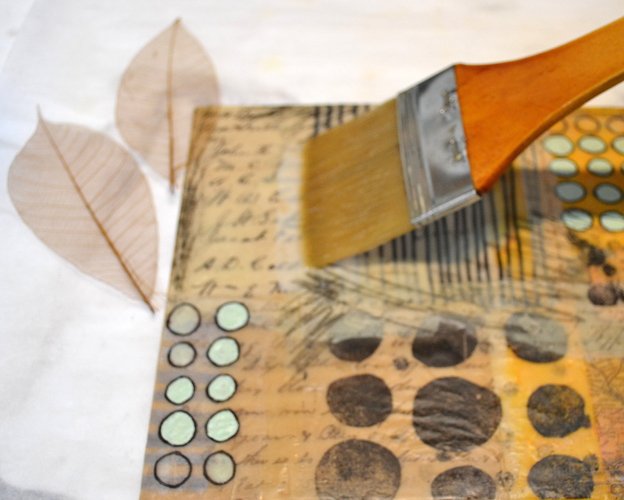
To add objects, brush a small puddle of encaustic medium to the area on your art where you’d like to place the object. Heat the puddle just before you add your object.
Dip your object into the encaustic medium and lay it on your hot palette to allow some of the excess wax to drip off. You can skip this step if your object cannot sustain the heat of the palette, or if you feel you do not need to pre-wax your object.
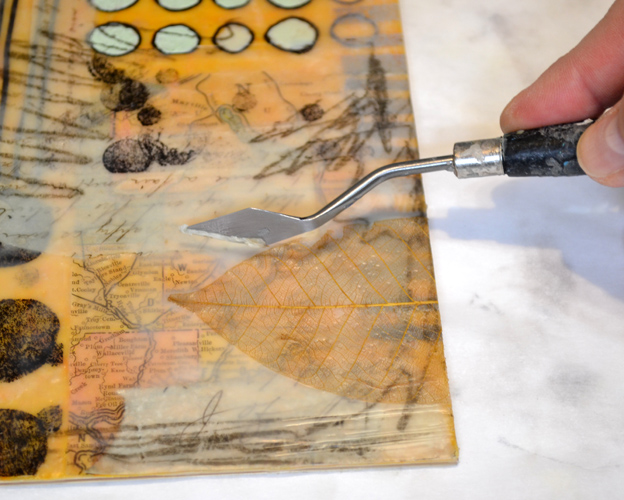
With a pair of tweezers, pick up the object and place it on the wax puddle on your surface. If your object is solid, give it a slight push into the warm wax to embed it in the surface. Fuse the area with a heat gun. If needed, with a small natural bristle brush, add more encaustic wax around the edges of the object to fill in any holes or gaps. I have added two skeleton leaves, which did not need pre-waxing, but I did add a thin layer of wax over top of each leaf before fusing. After the wax was cool, I scraped some wax off to reveal the lovely nature of the leaves.
The wax may sometimes appear cloudy when you are building layers to embed an object, but it should clear up as it cools. If it does not clear up to your liking or if you feel there is too much wax around your object, use a small palette knife to scrape away some of the wax and fuse again to smooth out any gouge marks.
You can still add encaustic paint or collage on top of objects if you’d like. I usually add objects as a final step, but it really depends on what your preferences are for your own work.
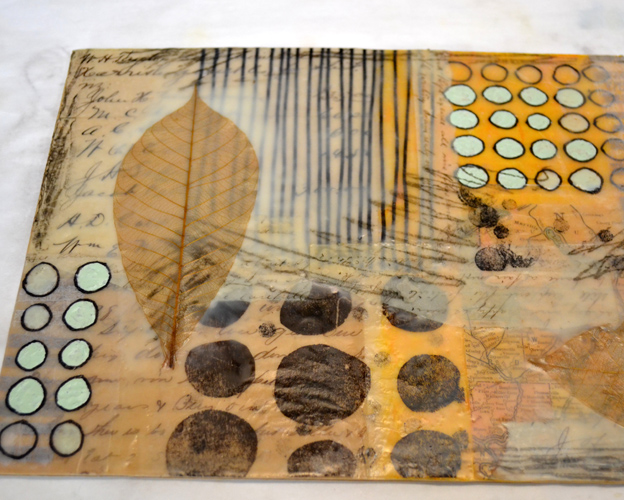
I continued to work my piece by adding some brighter colors with encaustic paint. I used Enkaustikos Hot Sticks Encaustic Wax Paint, Cadmium Yellow Medium on the right and Cobalt Blue Light, in the center of the black circles with a small brush. I also added some transfer lines around the perimeter of the piece with graphite paper. Once these additions were made, I lightly fused the whole piece.
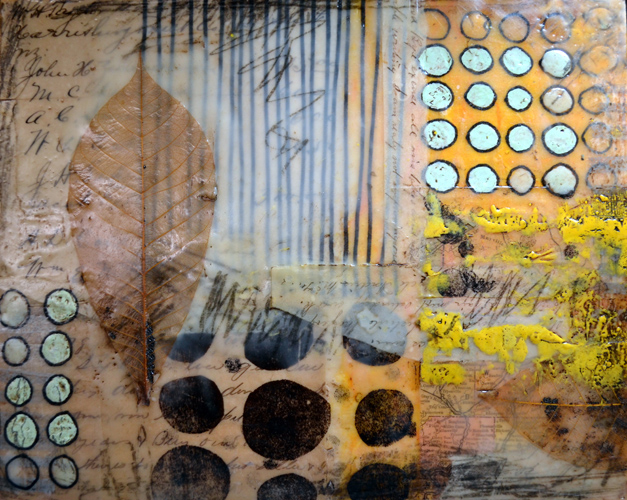
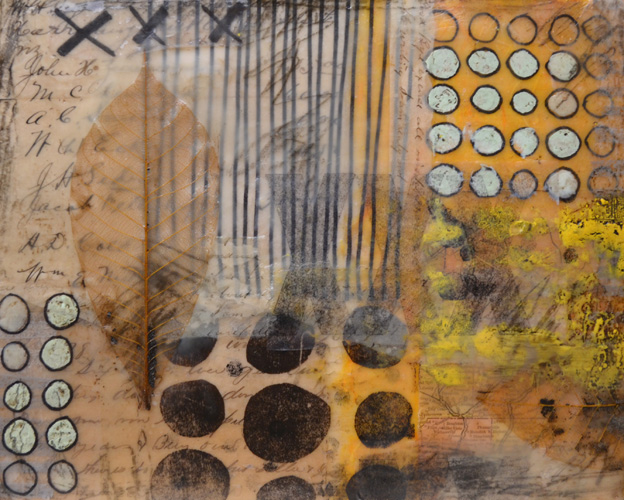
I still felt like there was something else needed on this piece, and after studying it for a while, I decided to add 2 sets of black x’s (Sharpie on white tissue paper in top left and stamped x’s on white issue paper with permanent ink in center) to balance the dark areas. Below is my finished piece.
You should now have enough information to get you started in encaustic painting. I have found this medium to be inspiring and exciting. I believe that if you practice these techniques, you will become more creative in encaustic painting. I will be writing additional articles here in the coming months about some of my favorite encaustic techniques. You can also visit my website, where I will be sharing more information about encaustic and mixed media painting.
Thanks for your interest!
~*~*~*~*~*~*~*~*~*~*~*~*~*~*~*~*~*~*~*~*~*~*~*~*~
Elaine Brady Smith loves creating encaustic and mixed media art. Key ingredients in her work are vintage papers and hand printed collage papers made with repetitive marks, simplistic shapes, and transparent layers. She also enjoys other art mediums, such as art journaling, oil painting, and colored pencil drawing. Among her other interests are writing, teaching and spending time with her family. Find more on her website: elainebradysmith.com and on Facebook: Elaine Brady Smith Art
~*~*~*~*~*~*~*~*~*~*~*~*~*~*~*~*~*~*~*~*~*~*~*~*~



Recent Comments