Michelle G Brown | Mixed Media Art

“Joy of Zentangle”

~ * ~

This article is written by Pauline Laing

Today we are going to review the book “Joy of Zentangle – Drawing Your Way to Increase Creativity, Focus and Well-Being” by Suzanne McNeil CZT, Sandy Steen Bartholomew CZT & Marie Browning CZT. This book was published by Design Originals, 2013.
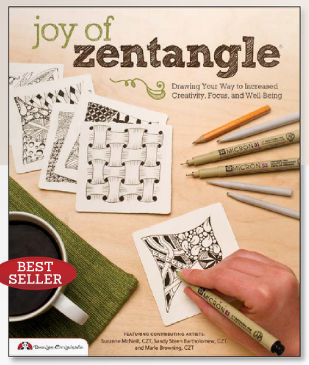
Book review - Joy of Zentangle

Zentangles have been on the scene for a few years now. Created by Rick Roberts Sharon Lesh and Maria Thomas, the Zentangle method is a simple drawing technique that they claim can lead to creativity and a feeling of well being. I already knew that the drawings people produce can be very gorgeous, so I was enthused about having a go.

This book has left me a bit uplifted, and also a bit angry! Uplifted, because it led me to pick up a pen and draw in a new way, undaunted by the challenge of the white page. But angry because of all the “business” surrounding the process.

Let’s dispense with the business topic first. A whole page of the book is devoted to it, and the rest of the book is written mindful of the fact that Zentangle is a business. We are told to use the verb “tangle” to describe what we are doing. We are told to credit the Zentangle method if we use it to produce artwork. We are offered useful products for sale at the official web site. On one level, ten out of ten to them for turning a creative idea into a viable business. But on another, I’m very uncomfortable thinking that someone else can own this process. I’m just doodling with a pen, for heavens sake!

But that’s enough business. So, what do you get in this book? There’s a nice bit of background about how Maria  and Rick created this method, and some genuine insights into the meditative aspect of drawing. Sorry, tangling. Then we get into a tutorial on how to create a basic Zentangle work. It’s nicely laid out, you’ll have no problem understanding. I enjoyed this bit.

Very soon we are into the juicy bit of the book, the directory of tangles! Definitely the best bit of the book, we get no less than 101 samples of patterns to use. And not just the pattern, but a step by step guide to how to produce them. Some looked really complex to me, but turned out easy to draw when I referred to the steps. I was delighted! Some pages also featured a photograph of a real life object that was the source of inspiration for the pattern. At least, I think that was why they were there. The book didn’t really make the connection here, and I thought that would have been a very useful aspect to add. These directory pages also feature samples of others’ work. I examined them to see the connection to the tangle featured on the page, but in most cases, there was none. A missed opportunity, surely! A few patterns didn’t really lend themselves to using in Zentangles, I thought. They looked more like just a drawing not a pattern suited to filling in a random area. I’d have preferred a little more guidance there. My complaints aside, this section of the book was so useful, I returned to it over and again.

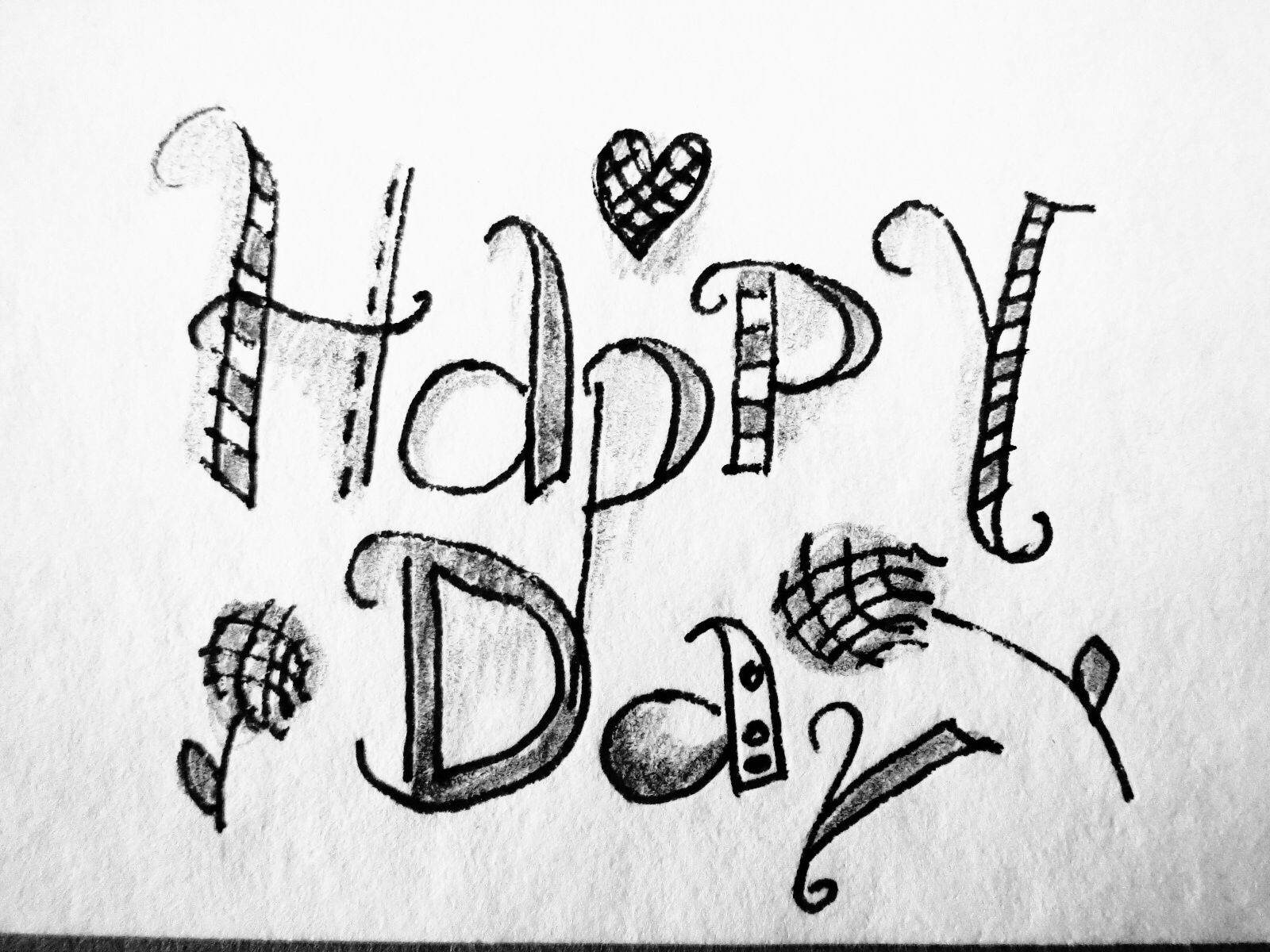
And did it make me more creative? I spent an evening tangling, and finished my first Zentangle. I decided to try creating an original pattern for filling areas. I flipped through photos on my iPad for inspiration. I never did get to creating an original tangle, because it was sidetracked by a very fun calligraphy project I suddenly thought of. So, was Zentangle a failure, because I stopped? Or was it a success, because it warmed me up for a more personal project? I’m going to say success, and based on my experience wit this book, I’d do it all again. And I’d flip through my 101 tangles again too!
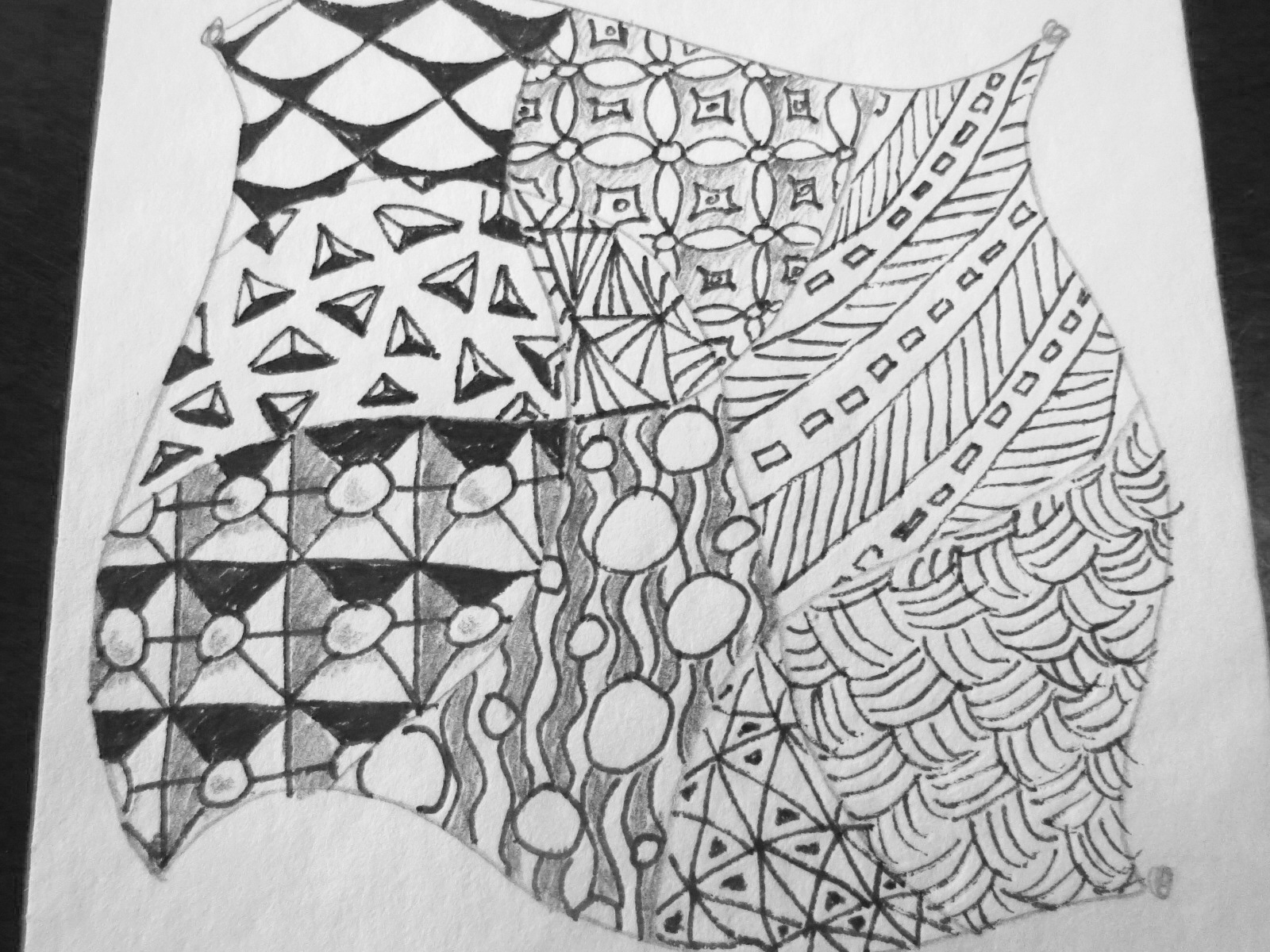
Book review - Joy of Zentangle

My first Zentangle

Book review - Joy of Zentangle

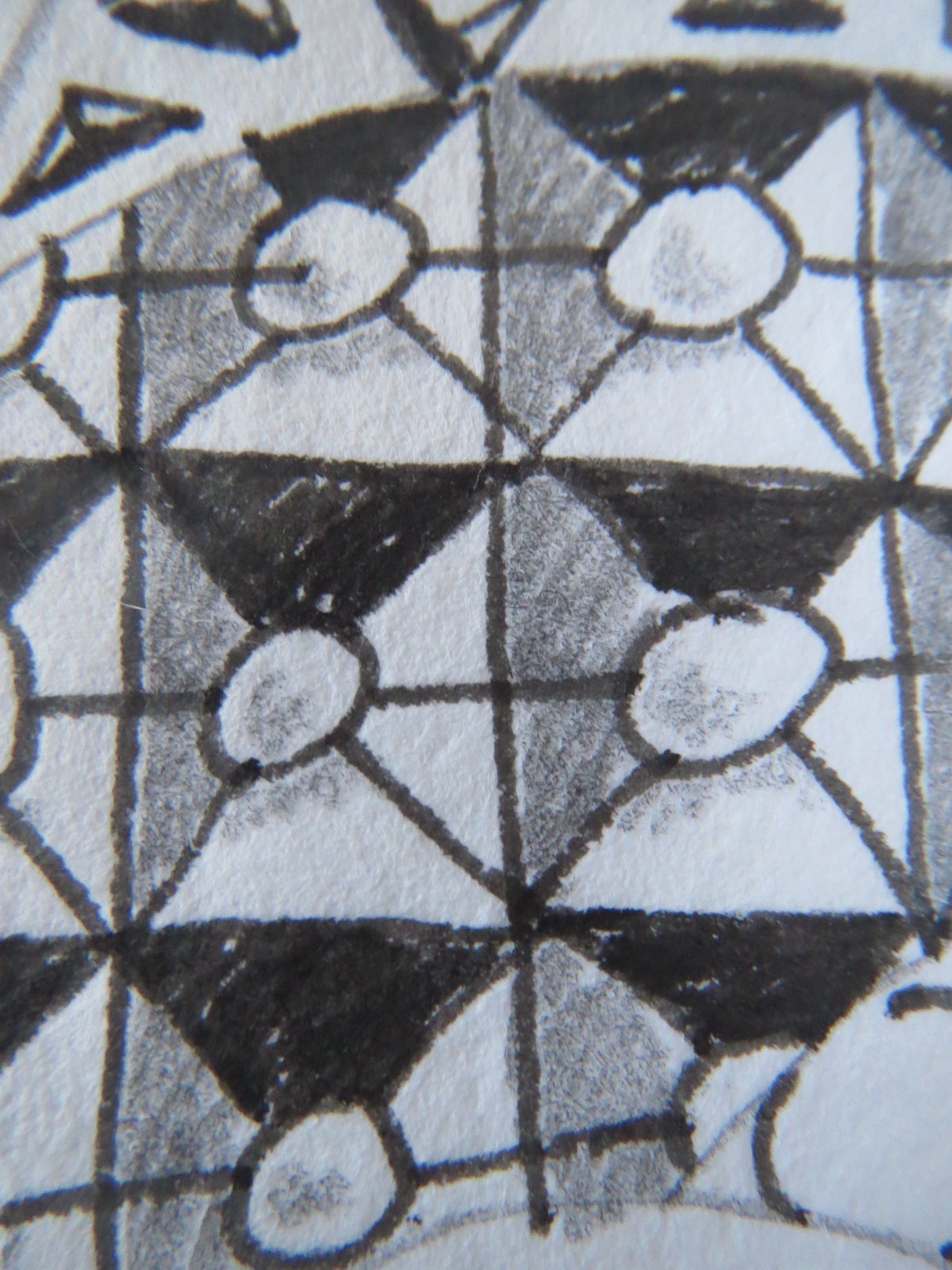
An eye popping pattern I know how to do now
Book review - Joy of Zentangle

Book review - Joy of Zentangle

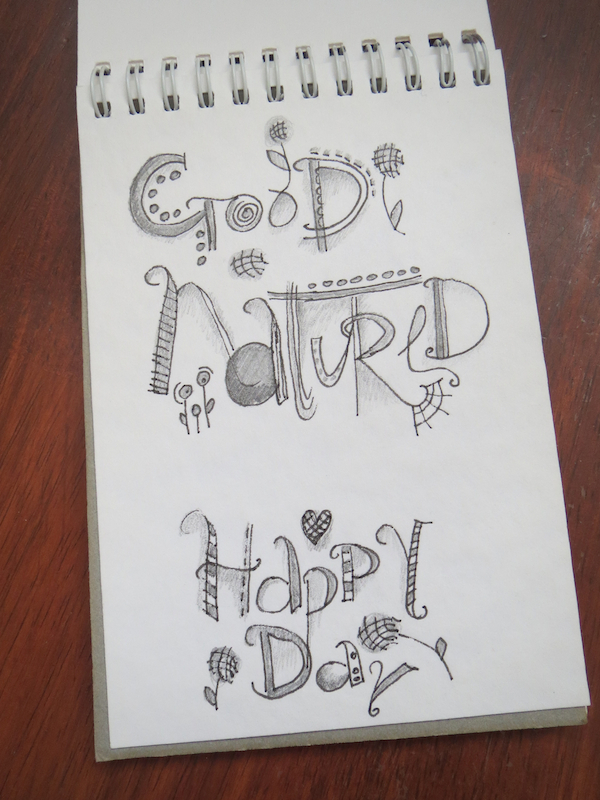
What happened once my pen was warmed up – not a Zentangle at all!

~*~*~*~*~*~*~*~*~*~*~*~*~*~*~*~*~*~*~*~*~*~*~*~*~

Pauline Laing is a Melbourne based crafter. You can see more of her work at: springchook.blogspot.com.au

~*~*~*~*~*~*~*~*~*~*~*~*~*~*~*~*~*~*~*~*~*~*~*~*~

.

.
Are we Collectors or Hoarders?

~ * ~

This article is written by Ann Strecko Koemen

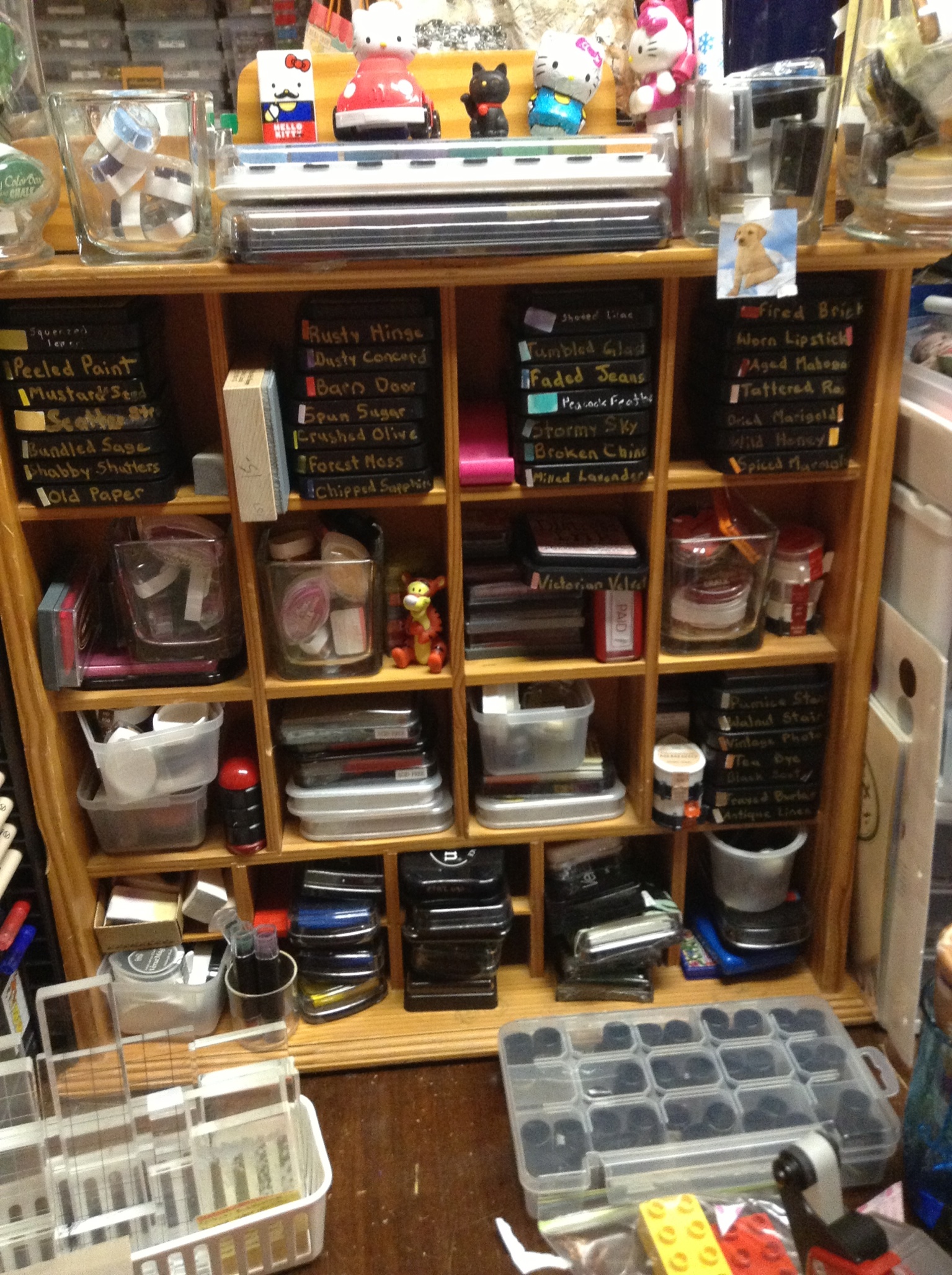
Whenever I have a new visitor to my studio/basement I often hear comments such as: “Oh my….you have so much stuff…” Most people just let their jaws drop open while their minds are trying to take it all in with their eyes wide open too! I also have heard: “How do you find anything?” Usually these comments come from my non creative voyeurs. My craftier friends and loved ones love my space but do express envy at the sight of all that I have. I have been accused of being a hoarder of course as well as being obsessive compulsive, a clean freak, and super organized. So I know to take their comments lightly. I believe these visitors have watched the American television program that likes to exploit people who have serious issues by scandalously sharing these people’s living quarters which are usually a health and fire hazard. I assure you that I do not come even close to that description. I live in a well maintained, clean, and orderly home on the main level. However, half of the basement is MINE!. I am after all an artist that dabbles in many forms of art and crafting, and so I am well equipped.

Tips on how you can fix your things

I thought I would do a little bit of research on this topic. By definition collecting refers to the bringing together or the accumulating of objects. On the other hand, hoarding, which by the way is an Americanized term, refers to the non specific collecting of anything and garbage with no goal in mind.

There is a fine line here between the Artistic hoarding disorder and Artistic accumulation. Let me shed some light on this topic to alleviate any fears.

Tips on how you can fix your things

Artistic accumulation involves care whereby one takes the time to store, organize, and even label accumulated materials for future use. Hoarding, does not.

There is also specificity involved in Artistic Accumulation, where the collector looks for materials which are related to a specific media or project. Hoarders are non specific. Artistic Collectors have Intent. Artists intend or have an idea as to why they are collecting the materials. The artist usually has a vision of the intended project to be. A hoarder has no such vision. Artistic Accumulation also involves production and creation, whereas hoarding has no vision of completing any project. The artist who accumulates a lot of materials also is balanced and will spend more time creating rather than collecting  the accumulating artist USES the materials. The Hoarder, does not.

Perhaps in future articles I will describe some of the many organizational methods I practice. Until then ….

be forewarned future visitors, my studio is big and full, it is also a productive and buzzing hive dominated by one super hard working Queen bee!

Tips on how you can fix your things

~*~*~*~*~*~*~*~*~*~*~*~*~*~*~*~*~*~*~*~*~*~*~*~*~

Ann is a mixed media artist collecting and living in the countryside of Ottawa,  Ontario Canada. She and her family live in a big house that can hold all her stuff and more!  No pets or family members have ever gone missing in there.

~*~*~*~*~*~*~*~*~*~*~*~*~*~*~*~*~*~*~*~*~*~*~*~*~

.

.
Family History Collages

~ * ~

This article is written by Anjuli Johnson

When I was finishing my history degree, I worked on a project that quickly became one of my favorites. The main stipulation was that all of my research had to be based on what historians call “Primary Documents”. Primary documents are direct evidence of the topic being researched, and were created by witnesses or recorders of the events. Examples of primary documents include journal entries, birth certificates, and newspaper articles.

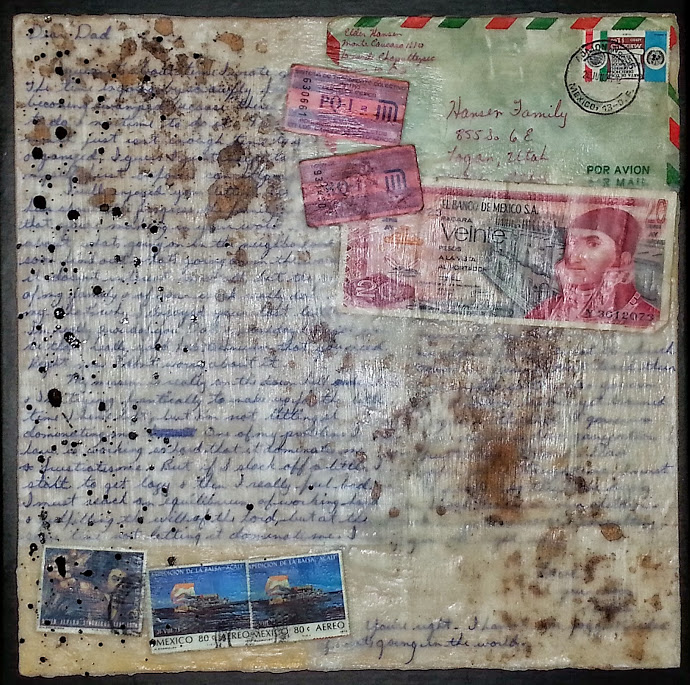
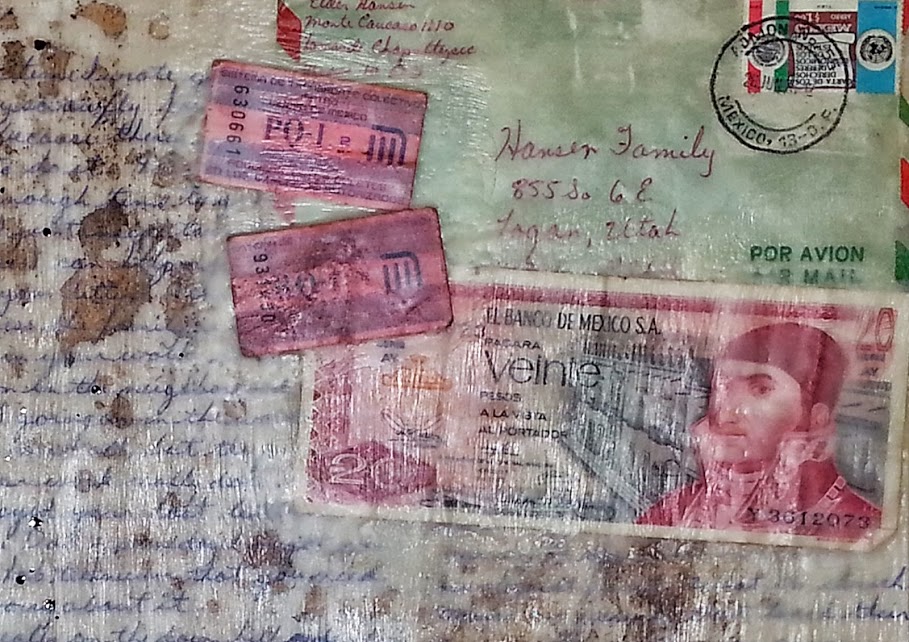
Collage using original letters of my father from 1974

I remember researching my project required hours in the library, searching through rolls of microfilm for hundreds of birth and death certificates and interpreting the information I found there. It sounds so tedious, but going through those letters and certificates and seeing the names of actual people, their handwriting, and the tiny portions of their lives that were recorded there- it was fascinating. I’m not sure what it is about old certificates and journal entries- it’s like they contain secrets that are just waiting to be discovered.

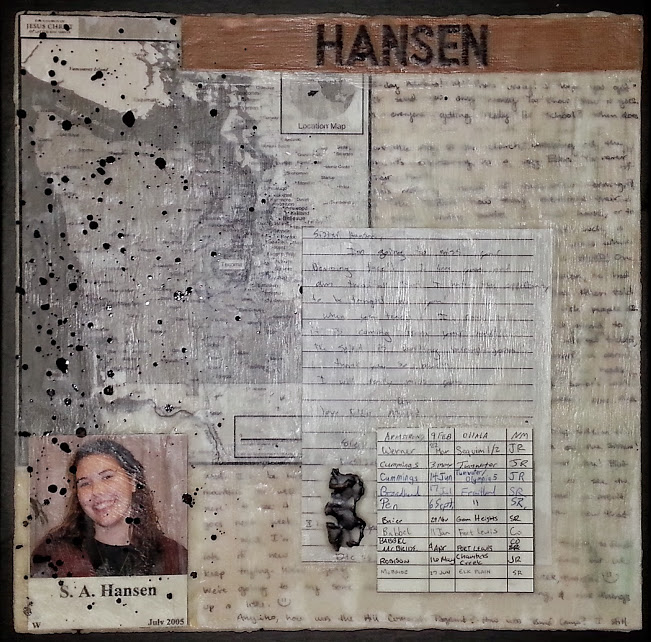
  Letters and memorabilia used in an encaustic collage with a family history theme.


When the journal entries and letters are from your own family, that feeling of fascination triples. A few years ago, my grandparents basement flooded and we had to bring out all kinds of boxes to keep things from being ruined. It was then that I discovered a cache of letters from my father to his family while he was a young missionary in Mexico in 1974-1975. What an amazing feeling, going through those letters, reading about my dad who at the time was even younger than I was. Seeing his handwriting, the little tidbits he had collected, the replies his parents sent him, pictures, etc. were just like a window to the past. As a historian, those documents represent the truth of who my dad is and was, as well as who I am, as his daughter. I want to immortalize that truth, to make sure that it doesn’t get buried at the bottom of a drawer or inside a box. How could I do that in a way that would be respectful, beautiful, and long-lasting?

mission ephemera in encaustic collage

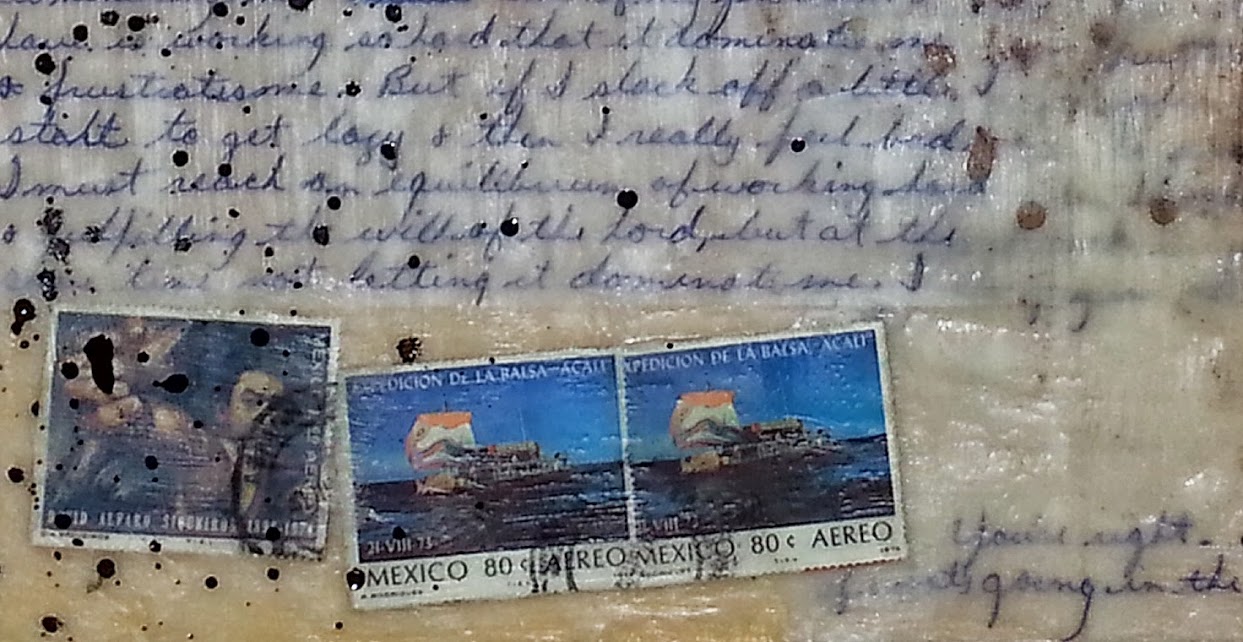
stamps embedded in encaustic collage

I decided on a set of encaustic collages- one of my Father during his mission and one of me during mine, 30 years later.

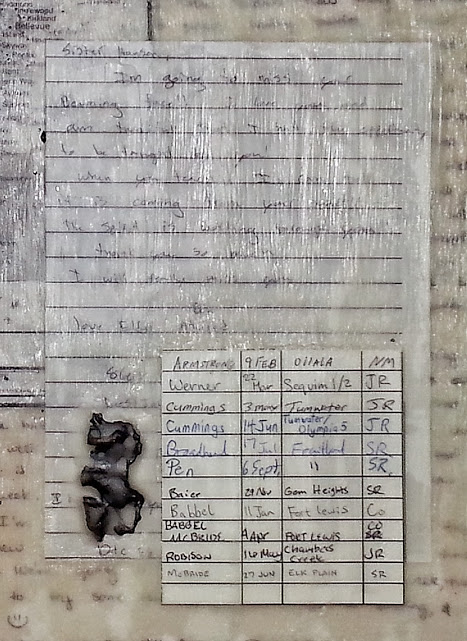
Since I knew I was going to be using primary documents, I started by choosing what to include and made copies and scans of every piece. I debated using the originals in my art, but I finally decided that the true value of my collage is in the fact that these are actual pieces of my own history. These artifacts represent my past, and by extension, my present and my future. Using printed copies just didn’t seem right, yet I still needed to make sure that nothing would be lost by including the originals in my collage. Once I have each piece framed, the letters I chose to include will be typed in their entirety and adhered to the back, so that even though parts of the originals are covered in the collage by wax and other elements, the whole letter can be seen simply by looking at the back of the painting.

The collage I created about my father is much more vintage looking than mine- I think the nature of the elements I used for his, and the fact that they are 30 years older adds to that look, but I also used rust in between layers of wax. To use this technique, I soaked a portion of steel wool in a white vinegar and water solution, and shook the droplets directly onto the wax. Once they dried, I was able to add more layers of wax and elements to imbed the rust in the middle of the collage. Adding the drops of India ink to the left side of each collage as a final touch brought more continuity to the set, as well.

original letter added to an encaustic collage

Don’t be afraid to showcase your family history through your art.  I will admit, I was a little nervous to be using the original letters of mine and my dad’s but to be honest, they mean so much more in this form than they do stacked in a box.  Collect your family’s primary documents, make copies and scans- you can even use the copies in your art if you prefer- but do something with your family’s memories that will spark interest and ensure that those memories are remembered and cherished, never misplaced or forgotten.

~*~*~*~*~*~*~*~*~*~*~*~*~*~*~*~*~*~*~*~*~*~*~*~*~

Anjuli Johnson is a Mixed Media Artist from Raleigh, NC.  She began her art career as a scrapbooker, and it’s been an evolutionary process ever since.  She loves all things mixed media- paper, paint, pens, wire, gears, clay… the list goes on and on.  She is constantly trying to push through her fears to discover and develop her talents, meet new people, and learn from those around her.  To see more of Anjuli’s art and techniques, check out her website at www.thefarpavilion.com  and like her Facebook page www.facebook.com/TheFarPavilion

~*~*~*~*~*~*~*~*~*~*~*~*~*~*~*~*~*~*~*~*~*~*~*~*~

.

.
Story Behind the Artist ~ Gaby

~ * ~

This article was compiled by Michelle G. Brown

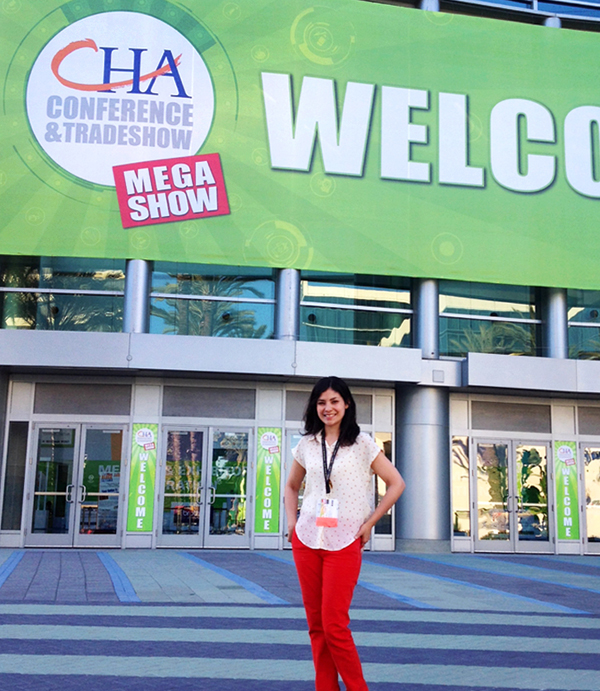
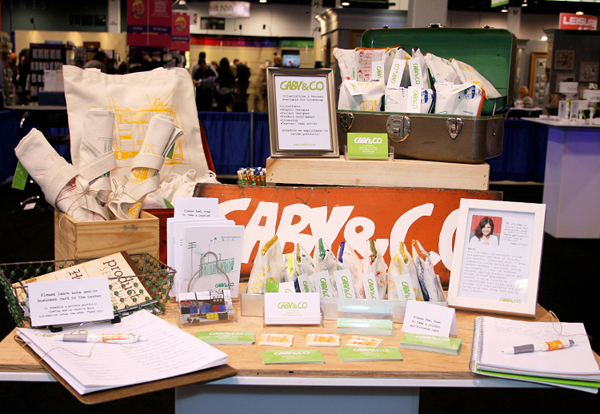
Michelle first came across Gaby’s work at the Designer Showcase at the Craft & Hobbies Associates Winter Show in 2014. Michelle was drawn to the combination of the illustrations and industrial in Gaby’s work and wanted to learn more about the artist behind the Showcase.

Graphic designer Gaby

Hi! I’m Gaby, illustrator, artist and pattern designer. I started Gaby&Co in September 2012 when I began commuting on the Metrolink Trains for the first time. I traveled to and from Downtown L.A. Monday-Friday to my graphic design job. I enjoyed my 1- hour commute because I was able to see many urban industrial sites. I already photographed urban buildings and colorful distressed metals, and in September I started to draw them as well. I began posting weekly illustrations on my website, which have now turned into daily sketches of street objects I come across while I travel.

Graphic designer Gaby

I graduated with a Bachelors Degree in graphic design and a minor in photography in 2004. I always enjoyed taking art classes of all mediums while in college and continued to take night art classes after graduation. I enjoyed working as a full time graphic designer during the day and then working on hands-on art at night. In the evenings I’ve taken photography classes, painting, ceramics, jewelry making/soldering, jewelry enameling, DIY design/collage, children’s books illustration, silk screening and a couple more classes I might be forgetting about.

In September 2012 I started to illustrate, urban buildings specifically because I was so attracted to them. That same month I created my website gabyandco.com as part of my commitment to post weekly illustrations. Early 2013 I began creating products with my illustrations and decided to attend my first DIY event, Patchwork Craft Show in Long Beach, CA.

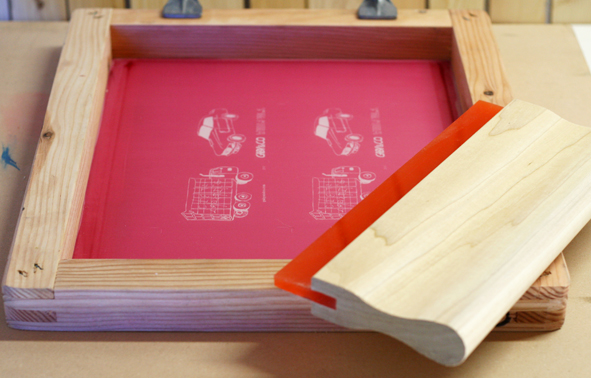
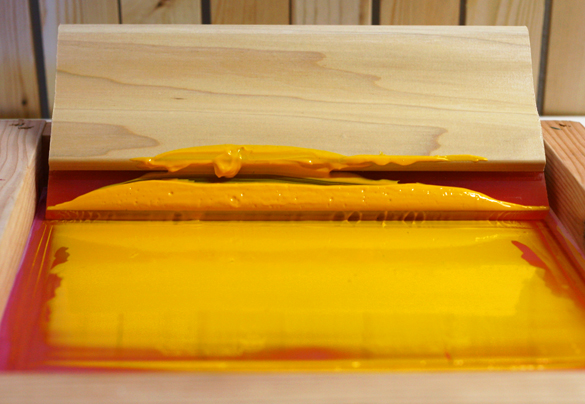
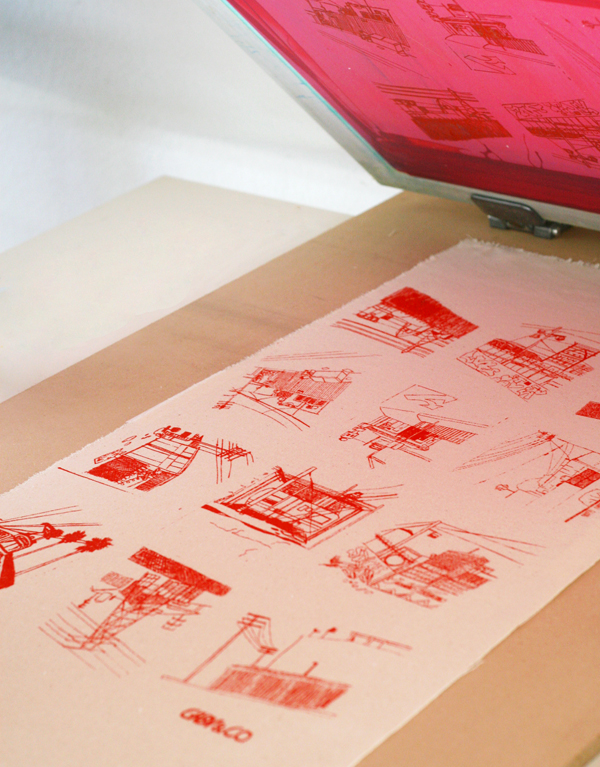
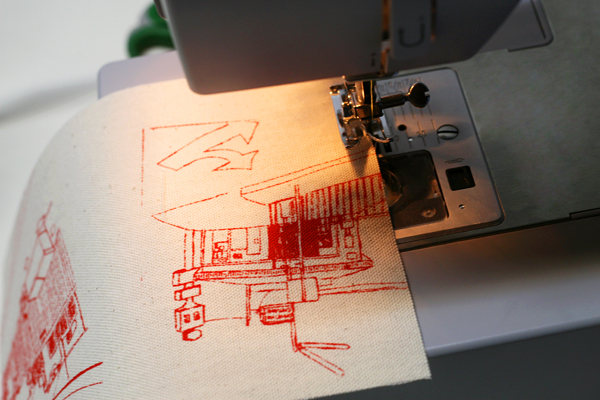
To help me prepare, my husband helped me silkscreen my illustrations on cotton fabric by using our homemade silk screen station. My mom, who is a wedding dress designer, taught me how to sew zip pouches and helped me sew a few for the show. I was so proud of the first run of Gaby&Co zip pouches!

Silkscreen printing on fabric by Graphic Designer Gaby

Silkscreen printing on fabric by Graphic Designer Gaby

Silkscreen printing on fabric by Graphic Designer Gaby

I also printed my first zine of illustrated buildings. I had a fun time at Patchwork and sold some of items, which meant the world to me. It made me realize that people are interested in my products.

Ever since Patchwork I have silk screened and sewed more products and have been lucky to be a part of other shows like Unique LA, the CHA Show, LA Zine Fest and look forward to participate in more.

machine embroidery on fabric by Graphic Designer Gaby

It’s been fun turning my illustrations into zines, zip pouches and other products.

I live with my husband Cesar, a terrier-mix and funny dachshund in sunny Southern California. Thank you for having me Michelle!

You can see more of Gaby’s work and connect with her here:

www.gabyandco.com

www.facebook.com/hellogabyandco

twitter.com/hellogabyandco

~*~*~*~*~*~*~*~*~*~*~*~*~*~*~*~*~*~*~*~*~*~*~*~*~

.

.