Michelle G Brown | Mixed Media Art

Altered Book Jewelry Box

This article is written by Anjuli Johnson
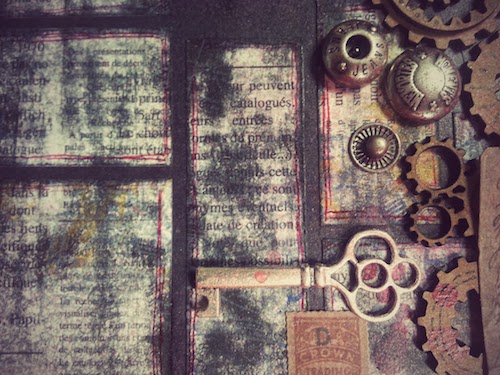
Box cover close up

I have been a fan of Tim Holtz for a loooooong time.  I mean, who isn’t, really?  His lines of scrapbook and art supplies are just delicious, especially to a steampunk fan who loves to add text to most of her projects, whatever they may be.

One of his products I’ve been dying to try was his configurations line- book boxes that are filled with interchangeable compartments.  These books are perfect for altering in just about any way possible, including my choice- a jewelry box.
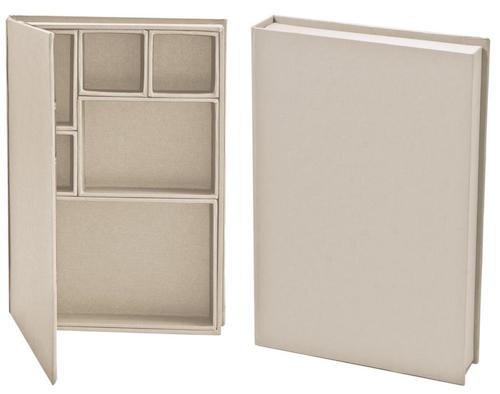
Tim Holtz configuration line

After altering the cover with lots of paper (notice all the text? I can’t help myself!), ink, chipboard, and paint, I used paper and fabric to line each box.  Using rolled up strips of the same fabric made my ring holder quite easy to assemble.  I didn’t even have to use glue- the pressure of the fabric rolls holds everything together, including however many rings I may end up adding to my jewelry collection.
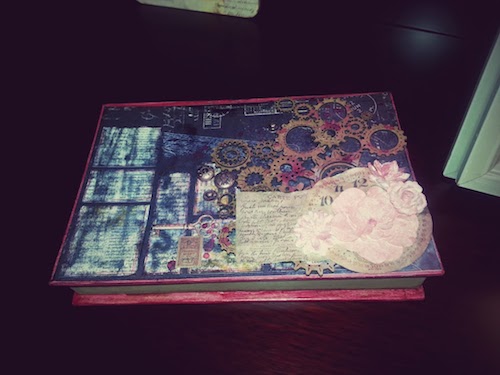
Cover shot

I’m so pleased with how this one turned out, that I think I’ll make 2-3 more and instead of having them lay flat on my dresser, I’ll mount them on the wall and add jewelry hooks.  At first glance they will look like a range of my favorite books hanging on the wall when in reality, it’s the rest of my jewelry nestled in unique little boxes, organized and adding quite a bit of charm to my little corner of the house.
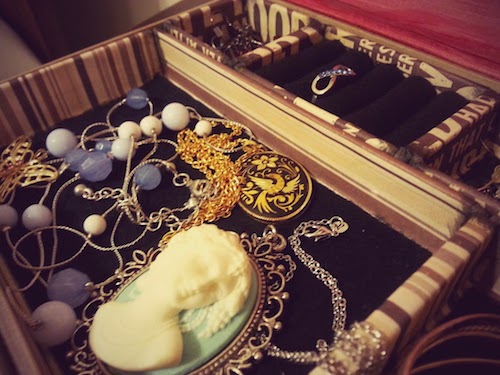
inside my jewelry box

~*~*~*~*~*~*~*~*~*~*~*~*~*~*~*~*~*~*~*~*~*~*~*~*~

Anjuli Johnson is a Mixed Media Artist from Raleigh, NC.  She began her art career as a scrapbooker, and it’s been an evolutionary process every since.  She loves all things mixed media- paper, glue, paint, canvas, pens, wire, gears… the list goes on and on.  She is constantly trying to push through her fears to discover and develop her talents, meet new people, and learn from those around her.  TheFarPavilion

~*~*~*~*~*~*~*~*~*~*~*~*~*~*~*~*~*~*~*~*~*~*~*~*~

.

.
Handmade mixed media books – a tunnel book

~ * ~

This article is written by Katja Blum

My son Sam introduced me to bookmaking. He makes lots of books with his speech therapist and loves the process maybe even more than the result. His books can be anything he wants – he can cut, glue, draw, paint, glitter and write. What’s not to love?

One of my favorite types of handmade books is the tunnel book.

These three-dimensional books consist of several pages with cutouts of decreasing size. The pages are connected with accordion hinges on both sides. Because of the flexible connection, the pages can consist of many different materials from thick watercolor paper to cardboard. One of my personal favorites is foam board, because it is so easy to hang things from to “ceiling” of the cutouts – and because the book will be very sturdy and not prone to warping.

Making a tunnel book is simple. Design the cutouts of your pages according to the picture or story you want to create. Remember that each cutout will be smaller than the one before, so any designs around the edge of the first page should be on the smaller side, so that you leave enough room for the others.

If you want to create elaborate figures or landscapes in your cutouts, you can always add them later (especially if you use thick, hard to cut materials). Just cut your designs out of decorated paper and leave little paper tabs where you would like to attach them to your cutout frame.

You need two accordion hinges per book page – minus one page. So, if your book has five pages, you need eight hinges.

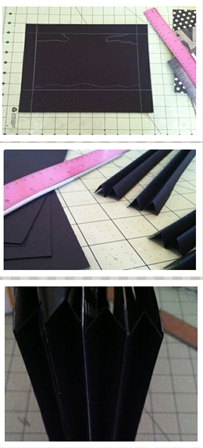
Cut strips of sturdy paper of the same length as the sides of your book pages you would like to attach. Fold the strips lengthwise into an “M” shape. Folding is easy, if you score the fold lines using a ruler and a bone folder, a butter knife blade or the tip of a knitting needle.

Steps for making a tunnel book – cutouts and hinges

Design, decorate and cut out your book pages and attach the accordion hinges. You can always add more decorations and elements later, as the pages remain pretty accessible.

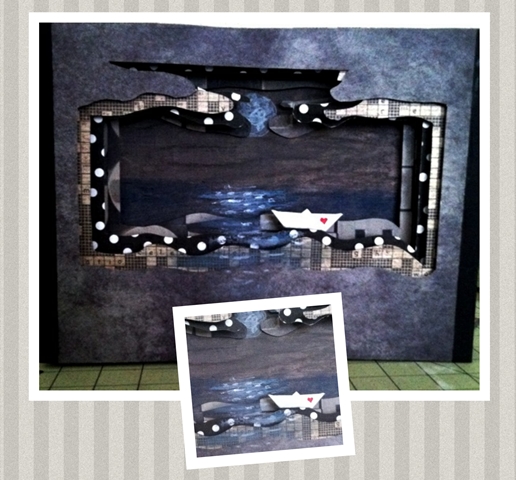
In the example here, I wanted to highlight several decorative papers I had collected, so I simply covered my book pages with the papers, cut them and added some details.

A finished tunnel book with decorative papers

Tunnel books are fun to play with and add to. Sam likes books about animals. What do you want your book to be?

~*~*~*~*~*~*~*~*~*~*~*~*~*~*~*~*~*~*~*~*~*~*~*~*~

Katja Blum is a writer and translator from Tulsa, OK. As an artist, she started with yarn, fabric and papier mâché (rarely together), branching out into collage and other paper arts about ten years ago. Her latest obsession is making soft stuffies and art dolls – to the delight of her son. She also likes to find creative solutions for ugly or broken things around the house – to the delight of her husband.

You can see more of her work with fiber, paper and words at www.thewaywardsheep.com

~*~*~*~*~*~*~*~*~*~*~*~*~*~*~*~*~*~*~*~*~*~*~*~*~

.

.
The Courage to Start

This article was written by Martice Smith II

The Courage to Start 

It’s something we all experience: the crippling plague of self-doubt and anxiety. (And, of course, it comes in varying degrees of intensity.) When starting a new illustration or painting, even I have caught myself saying “What if I mess up” or “How can I do that when I can’t even do this?!”

It’s easy to run away from what threatens us but at some point, we must push ourselves forward and beyond this low-level of self-criticism. It does not serve our higher purpose of becoming the artist we envision ourselves to be.

Here are a few nuggets of wisdom that I’d love to share with you. These tips have helped me tremendously in times where that nasty inner critic pops up and tries to flip every positive thing upside down.

1. First, we must allow ourselves to become immersed in positive thinking and effective affirmations.

Instead of saying “I’ll never be that good. I should stop right now and try something else”, elevate your thinking by saying this instead, “I can do anything I put my mind to…watch me!”.

Set your intention, empower your thinking, and express your thoughts into SPOKEN words. Yes, go ahead and say them out loud, so that you can hear them yourself. Listen to the way you speak to YOU. Are you gentle? Do you smile when you hear your words?

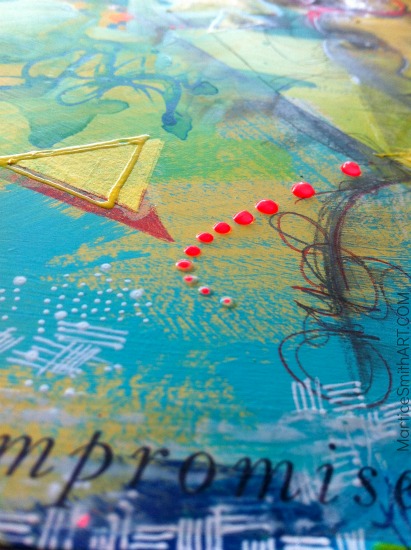
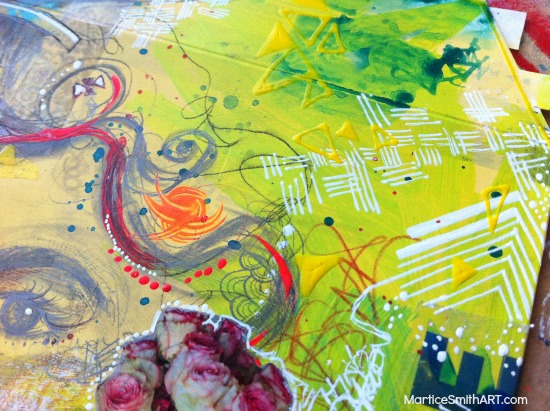
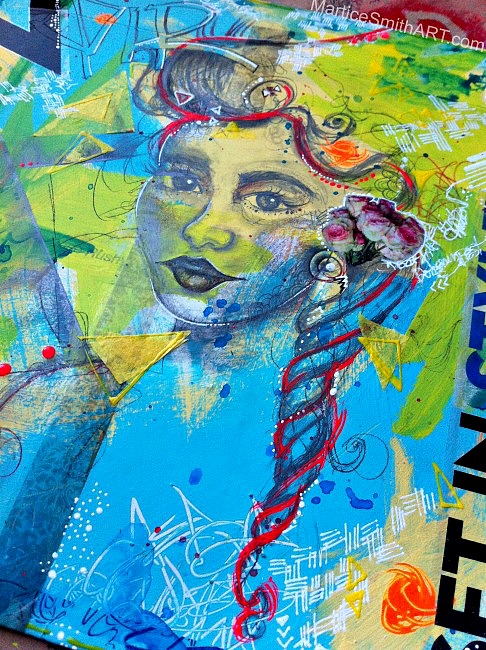
"Never Compromise", illustration by artist Martice Smith II

“Never Compromise”, mixed media illustration by artist Martice Smith II

Repeat your words until you are fully confident in them. It is YOUR belief in them that makes them come alive.

Now, as you build your courage on stable ground, remember to:

2. Allow yourself time to develop.

It takes time to learn and experiment with new techniques. Set aside, at least 15 minutes a day for creative exploration.

Break things down into manageable chunks and celebrate the small things, too. Show your enthusiasm and others will catch on and celebrate with you!

Every time you draw something, know that you will get better. You’re making progress and that surely puts those negative thoughts in their place, right?

You have to be willing to put the work in to get the results you’re looking for. Your first drawing may not look all that great to you; maybe the eyes are crooked, the composition doesn’t feel intentional, or there’s an unsightly knot in the middle row of your hand-woven basket…all of these “mess ups” can stop us in our tracks. Defy the urge to quit!

detail of "Never Compromise", illustration by artist Martice Smith II

3. Ask for help.

You are not on this great art journey all by yourself. There is always someone else you can reach out to. Be brave and write down a list of people you admire and reach out to, at least, one of them.

You can also participate in online art groups and connect with many individuals who are more than happy to give advice and share resources with you.

detail of "Never Compromise", illustration by artist Martice Smith II

Supplies used for the illustration: 

  • Large envelope – Size 12.5 x 9.5 inches (I used one from my local Postal Service)
  • collection of image transfers (from magazines)
  • Graphite
  • White ink pen (Uni-ball Signo)
  • Colored tissue paper
  • Spray varnish (matte finish)

DecoArt Products:

  • DecoArt Media Fluid Acrylics, Americana and Fluorescent Acrylics
  • Decou-Page – Napkin sealer
  • 3D Gloss Enamels Transparent Glass Writer – Yellow
  • Liquid Glass

Using acrylic paints, paint directly onto the large envelope with bold, expressive strokes. Let paint drip and splatter!

Create dots with the handle end of a paintbrush. Determine where your image transfers will go. Cut out words and letters and arrange them into graphic elements that make bold statements. Embellish with collage and mark-making techniques, your personal symbology, patterns and doodles. Spray entire surface with a light coating of matte varnish.

Now, you can bravely and confidently declare that you have the courage to start.

Cheers to your success!

~*~*~*~*~*~*~*~*~*~*~*~*~*~*~*~*~*~*~*~*~*~*~*~*~

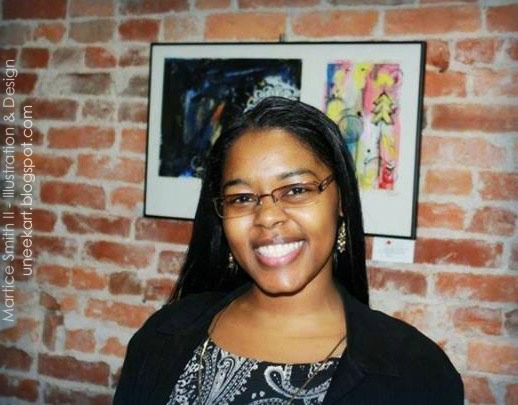
Photo of artist Martice Smith II

Martice Smith II is creative director of Martice Smith II – Illustration & Design Studio, based in Missouri and owner of Uneek Art Boutique. She established herself as a freelance Illustrator and graphic designer after receiving her Bachelor of Arts Degree. Her stunning illustrations reveals her love for fashion, typography and wildlife- using a combination of traditional and digital techniques.

You can see more of her work via her Facebook page or The Uneek Art blog.

Be sure to join the Uneek Art Letter, -Martice’s monthly newsletter- that offers art biz tips, advice and more digital goodness that will keep you inspired to be the artist you envision yourself to be!

~*~*~*~*~*~*~*~*~*~*~*~*~*~*~*~*~*~*~*~*~*~*~*~*~

.

.
The Fear of saying No in the Art and Craft Community

~ * ~

This article was written by Melanie Statnick

Success can be based on the reflex habit of saying yes to every opportunities that is presented to us. Some of us say yes out of fear we’re sending a message that we’re not that interested. As we succeed in our ventures we attract bigger opportunities and we then have to consider how valuable out time is as an artist. We don’t like to disappoint people and that can emotion can lead to becoming the “yes man/woman”

To gracefully say No is about managing our feelings and asking yourself some questions before you answer. We want to avoid the Burn Out. Sometimes we have the feeling of doubt which can stem from fear again of “Do I really want to turn this down? Will this opportunity present if self again if I do say no?”  By saying yes we relieve the anxiety of the situation only to find later down the road we regret our decision.

Perhaps it has become stressful to find the time or the inspiration to continue, you guilt yourself into thinking “Well I committed so I have to see this through”. Perhaps it comes with a financial burden and you can’t afford to keep going. That is when yes becomes stress.

Let’s think about this fear of losing an opportunity. How many opportunities will come along in your life time?  Many. How many and I going to safely be able to answer yes or no to? That depends on how you value your time, energy and talent. Let’s face it supplies cost. You can coupon clip till you have paper cuts but either way your spending your hard earned cash to make 20 or more cards, wreaths , paintings e.c.t on either friend’s kids parties, strangers/clients or family. I used to love to “give away” my artwork to places that contacted me about silent auctions for saving dogs, renovating art galleries, pancake breakfast, saving dolphins in oil spills. I have stopped. Because in reality the money being spent is on the cause, and has little to do with value or your artwork.   Something else that may guilt you into saying yes is the double edge sword of Exposure/Marketing.

How many of us went to school for business and or marketing then became an artist?  Not me.  I know how to create art, but I know very little about the business side. Do I want to start a business or do I want to sell my name or better my Art? This is an everyday challenge for most of us and when the opportunity arises to get your “name out there” you still have to ask yourself some questions. Who am I affiliating with? Is this really going to get me more exposure?   Ask for time to think about it. Pressure on lost opportunities can push us into a something we can’t commit to out of fear.

Overcoming the fear of saying no to opportunites for our art

Learning to say No for some of us is foreign and uncomfortable however those feeling can be overcome with practice.  Unless you enjoy volunteering your efforts and overachieving gives you’re a high chances are you’ll find yourself exhausted and your mojo will take a vacation without you.

5 Things to consider the time you’re faced with an opportunity for your artwork or craft experience.

  1. Do I have time for this?
  2. Do I have enough knowledge on the subject to teach it?
  3. Can I afford this Art retreat, Travel expense and or supplies without worrying about the money being spent?
  4. What can I learn from this opportunity that will benefit me in future opportunities?
  5. Do I mind not being paid again?

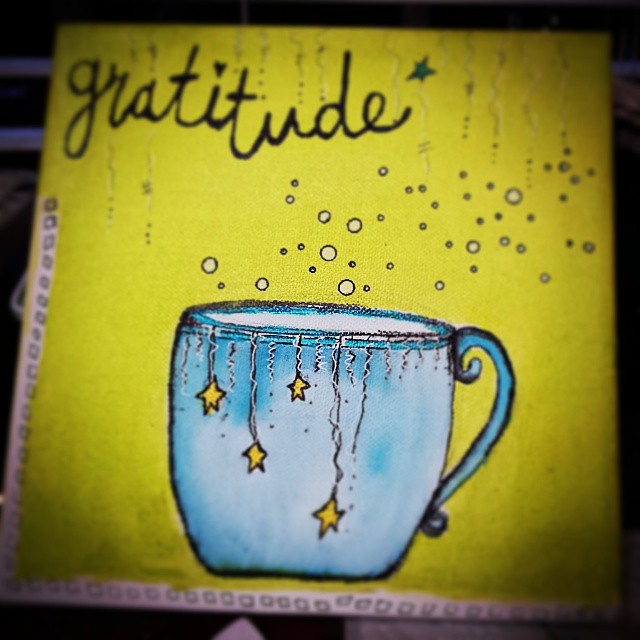
Remember that you are worthy of every exciting opportunity that comes your way and don’t let this create a fear of saying Yes! Opportunities can bring about friendships and furthering your skills and those are joys in life. Your time and talent is valuable and let this inspire you to make positive choices for yourself. Finally don’t forget to show gratitude for every door that opens.

Happy Creating!

~*~*~*~*~*~*~*~*~*~*~*~*~*~*~*~*~*~*~*~*~*~*~*~*~

Author Bio:

Published Writer/Artist Melanie Statnick was raised in Ontario Canada. For over 12 years Melanie has called eastern North Carolina her home. Melanie continues as a self-taught artist and teacher of visual arts and an article writer for Mixed Media Art co Melanie’s work can be found extensively throughout North Carolina with private collections abroad.

Melanie’s successes include written publication of articles in Interactive Artists Magazine, Publication in Somerset Studio magazine, Altered Arts magazine, and 2013 edition of Wilson Woman Summer issue.  Melanie’s awards are 1st place in viewer’s choice in Washington NC and 2nd place magazine cover choice with Altered Arts magazine. In 2015 you can find her work in Dawn DeVriesSokol book “A World of Artists Journal Pages”.

You can follow Statnick on her website at: www.melaniestatnickart.com

~*~*~*~*~*~*~*~*~*~*~*~*~*~*~*~*~*~*~*~*~*~*~*~*~

.

.