What is Mixed Media Art?

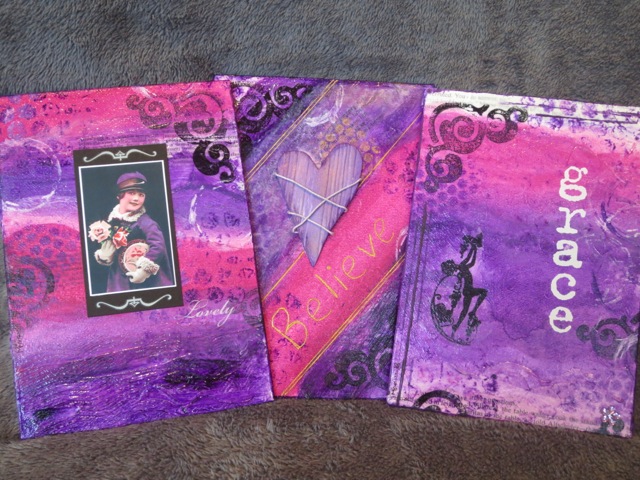
The term “mixed media art” is a broad definition that covers many arts and crafts, including collage, assemblage (both 2D and 3D), altered objects, including books and boxes, handmade greeting cards, artist trading cards (ATCs) and tags, art journalling and book making.

Hanging Art

Hanging Art

The “mixed media” used includes paints, papers and board of all descriptions, glues, buttons, fabrics, found objects, photos, metal bits, fibres, things from nature, inks, pencils, crayons, markers, pastels and polymer clays, to name a few.


What materials do I need to get started?

The beauty of mixed media art is the flexibility to start with things around you and expend from there. To get started you need a substrate or base. This could be a clean sheet of paper, sketchbook, a cereal box or anything else that may be sitting still.  Then, if you are heading down the collage path, you’ll need something to stick with (glue sticks are fine to begin with) and something to stick on (coloured papers, newspapers, catalogues, and anything else that grabs you).

If you are heading down the drawing / painting path, then once you have your substrate, you’ll need something to make a mark, whether its pencils, paints, crayons, markers or pastels.

Any or all of these are all you need to get started. Just use the things you have around you

What skills do I need to get started?

Another attractive feature of Mixed Media Art is that you don’t need fine art or drawing skills. That doesn’t mean you are excluded from mixed media art if you do have these skills, but it opens up a world of creativity for the rest of us who like to make things but “Can’t draw”.

The skills you need to get started are as simple as being able to use a pencil, scissors and glue. These skills will expand and develop with practice, depending on which “branch” you follow.  More complicated skills of mixing paints and developing your “artist eye” will happen as you expand your own creativity. Specific skills for particular media or art types will present themselves as you move into these areas. As with many things in life, the techniques and teachers will appear when you are ready.

Technorati Tags: , , , , ,

Creating layers in Mixed Media Art; Rub Ons


Rub-ons are wonderful embellishments for our mixed media painting. They are commercially available and no longer limited to the letters of the alphabet I remember as a child.  I love rub-ons because they can easily be applied to many surfaces. They can be positioned accurately before being applied and repositioned if you want to try different locations.

Creating layers in Mixed Media art with Michelle Brown


“Rubbing” on the plastic front sheet releases the rub-on from the sheet onto your artwork. You need to hold if firmly while rubbing, If you look closely, you can often see the rub-on looking a little lighter and this is where it is moving away from the sheet. Before fully removing the sheet, lift a corner and check it is all removed. If there is still part of the design attached, put it back into place and rub a little more in that area. Check again and remove sheet if design is all attached. To check it is well stuck done, I like to place the backing sheet back over the rub-on and press further with the back of my finger nail.

creating layers in Mixed Media


The variety of alphabet rub-ons make adding personalise wording to any artwork easy. They come in many colours but I prefer the versatile black and white. If you find the white is too stark for your grungy work, you can carefully sponge a little sepia ink over the lettering once in place to take some of the whiteness away. Using alphabet rub-ons is a brilliant way to add names to really make your gift special.

Mixed media art journal with Michelle Brown


Rub-ons now also come in fantastic patterns, borders, swirls and images – these are great to add to your mixed media painting too and once they are in place, there is very little around the image itself, making sure your gorgeous background shows through. The rub-ons can provide a more solid and detailed image as compared to the other layering techniques we have mentioned, without having to worry about blending.

Mixed Media art journal by Michelle Brown


I hope you keep an eye out for these Rub ons and build up a collection.

Happy layering!

art journal by Michelle Brown

.


.

.


Technorati Tags: , , ,

Mixed Media Artist – Francesca Albini


Today we have Mixed Media Artist Francesca Albini sharing two of her journal layouts.  Our Mixed Media Art community is a diverse bunch and over the last 5 months we have shared work from all around the world. Each artist has had different interests, reasons why they create and a wide range of skills.

Let’s let Francesca tell us her story…

~*~*~*~*~*~*~*~*~*~*~*~*~*~*~*~*~*~*~*~*~*~*~

I am a visual artist using pretty much every media and tool that exist, from digital painting to 35mm plastic cameras. I especially love using children’s art supplies and anything colourful and interesting. I collage, paint, draw, photograph, to record feelings and memories of places and emotions. I’m Italian, I live in London, UK, with my husband, and I love travelling to warm countries, deserts and oceans.

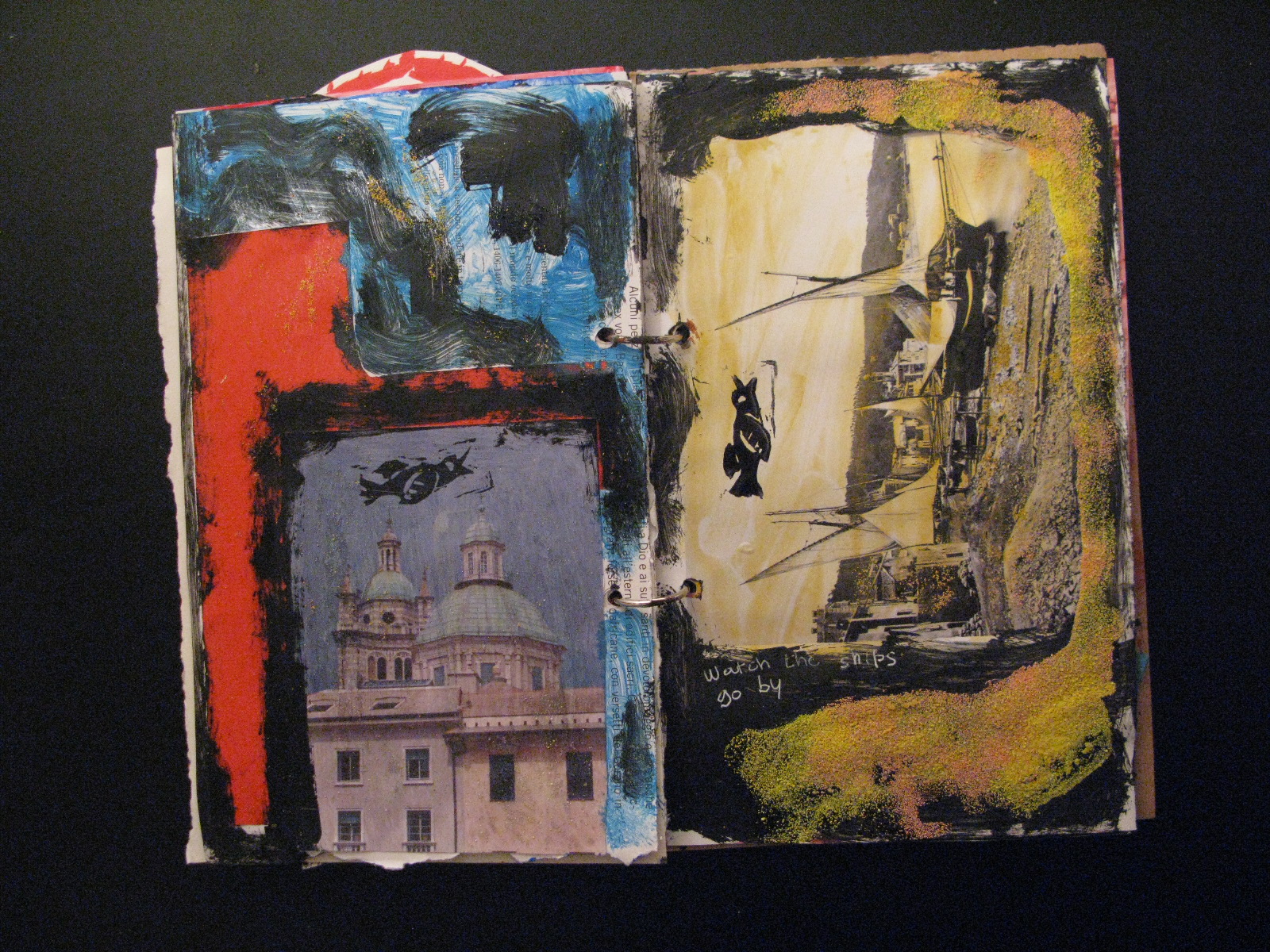
I’d like to share with you 2 pages from my journals. The first one is a junk journal. I find them a great way to record my travels . I bring with me a hole puncher and some hinged rings, then I collect whatever scrap paper I find, leaflets, pages from books, anything relevant to my travel and I work on that, adding my own photographs, glazes of paint, and text.

Mixed Media Art journal

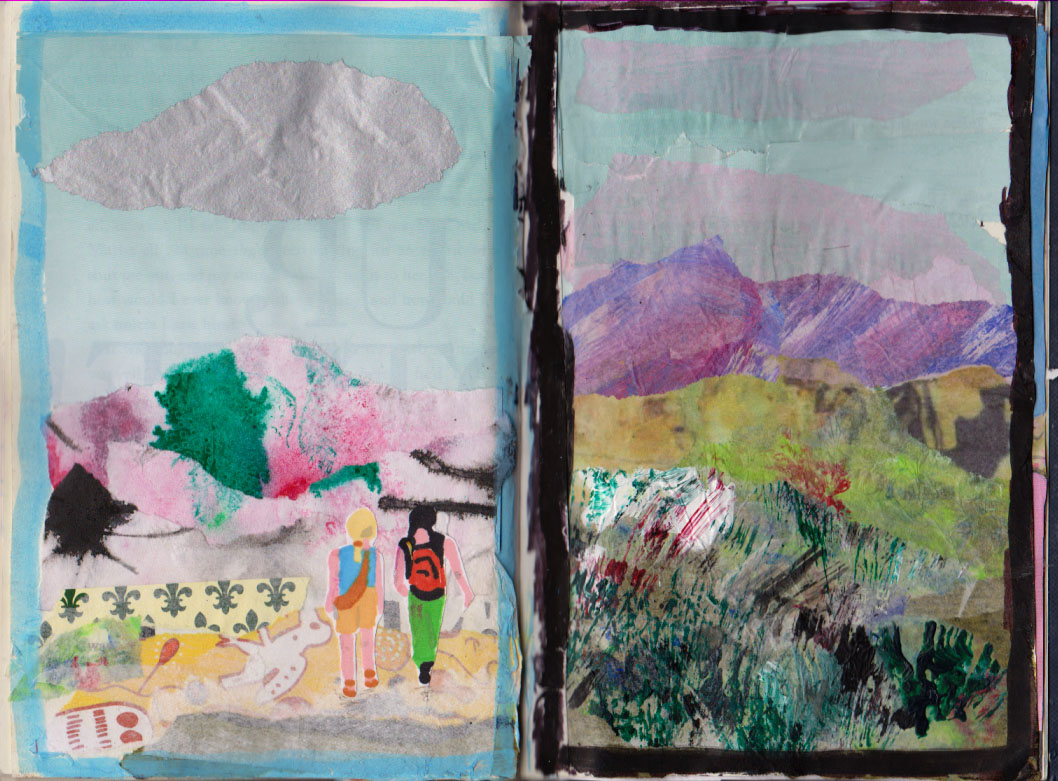
The second picture is from an altered book. I like creating landscapes with layered found paper and tissue paper. I paint white tissue paper to give it a feel of a grass field or rocks, then rip it with my hands and laminate it with PVC glue.

Mixed Media Art Journal

To see more of Francesca’s  artistic endevours, you can visit her blog: http://franjournal.blogspot.com/

~*~*~*~*~*~*~*~*~*~*~*~*~*~*~*~*~*~*~*~*~*~*~

Thank you for sharing your work with us, Francesca.

.

.

Technorati Tags: , , ,

Creating a Mixed Media Art Journal

Creating a mixed media art journal page uses many of the mixed media techniques we have discussed previously. Art journalling give you a chance to bring all of those techniques together to create a piece of art that is uniquely yours.

Start with a book ready for altering, a sketch book or a notebook. Open to a new page and give both pages a good coat of gesso. Remember to be aware of the brushstrokes or scratchings you put into the gesso; these will still be visible and add texture to the finished design, after the paint has been added.

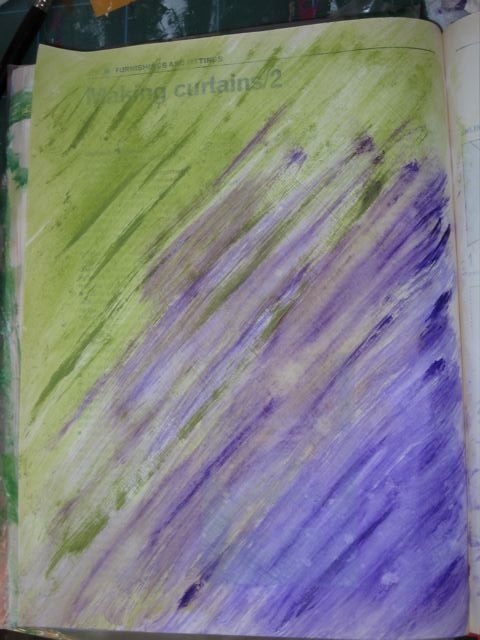
Next add some colour. Here I’ve chosen a green and a purple, both craft paints. They have been added at a diagonal, using first a dry brush, then a wash after the first layer is dry.

Adding green paint to mixed media art journalAdding purple paint to art journal

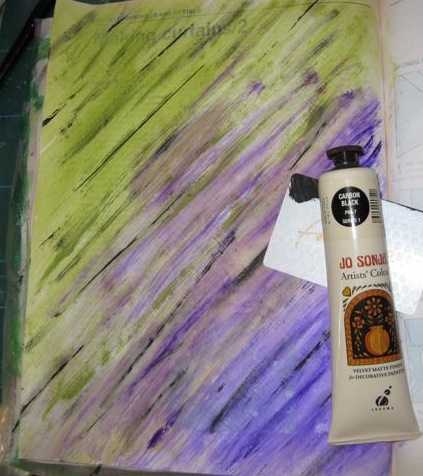
To tie the two colours together and to “dirty” it up a bit, add a little black paint, using the edge of a credit card to create thin lines.

Adding a little black to an art journal

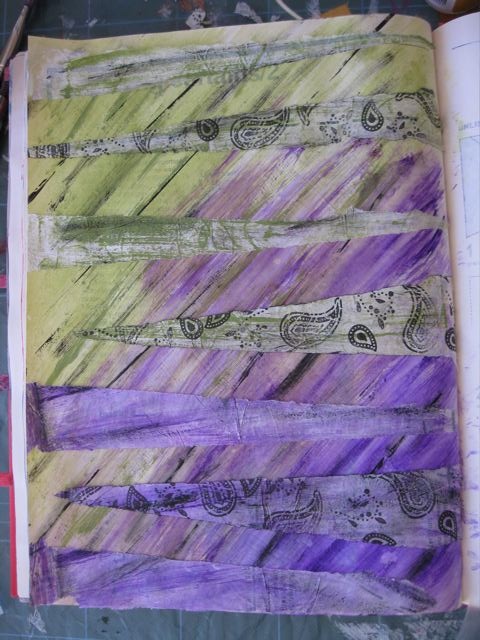
To add further layers, paint on some tissue paper with matching colours and tear into strips. These can then be stamped and edged with black ink. Glue these onto the page. Ink used here is Brilliance Graphite Black. Stamps are from See-D’s Perfectly Paisley set (#50326).

Adding colour matching layers to add texture to background

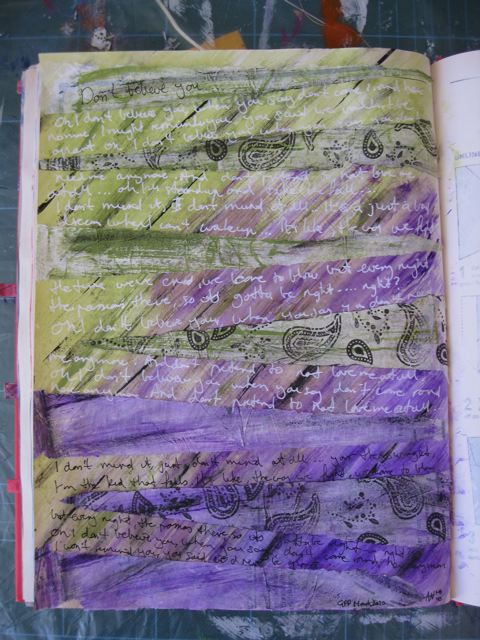
Now your page is ready for journalling. I have used a white and a black gel pen of the Uni-ball brand. Both wrote well and dried on the paint. Take care when writing onto layouts; you may need to heat set your writing with a heat gun. Also some pens don’t write well on gesso.

Writing added with gel pens onto art journal

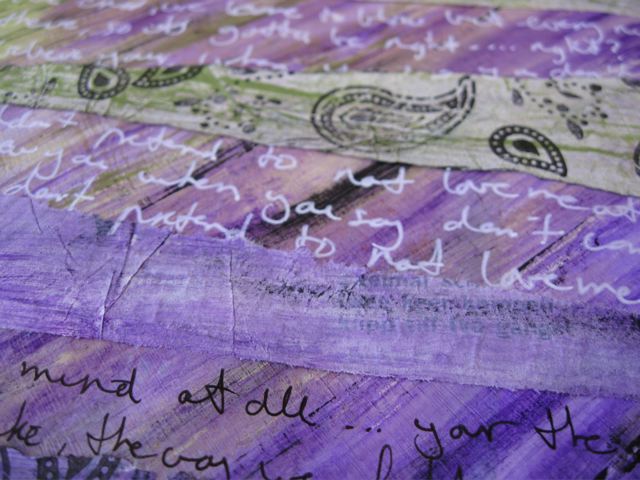
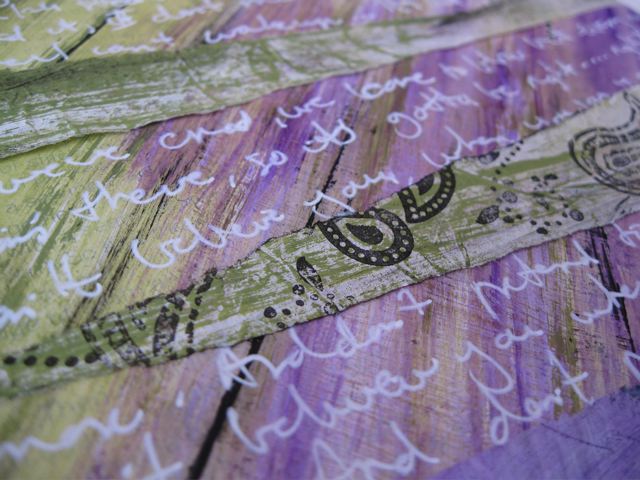
The brilliant aspect of art journalling is that you can write about anything; it does have that journalling aspect to it! Lately I have had the words from Pink’s song “I don’t believe you” going through my head. I have written the words out, as best as I can remember them. And like any song that just keeps going through our heads, I may not have started at the beginning, or finished at the end, or repeated the right bits…. but it is a reflection of the melody that is flowing through my brain.

Detail picture of art journal layers and writingWriting detail in art journal

I hope this introduction to art journalling will inspire you to give it a go. If you have completed some mixed media art work or altered book before, then the step to journalling is taking faith in your handwriting and what you want to say. If you are just beginning, then the best way to learn is to get started, start painting, start stamping, start writing. Only then will your skills grow.

And remember that this is for you, so choose the colours and images you love. You don’t need to share it with anyone. And don’t worry about your handwriting ~ while you may not like it, it is a part of you and that is what we are putting into our journalling.

If it all goes really bad… you can always gesso over it and begin again. But please sleep on it first; you may be surprised how a fresh set of eyes can appreciate your own work much better in the morning!

Happy creating!

Technorati Tags: , ,